Americans abroad · Croatia · European travel · ex-pat life · international travel · Plitvice Lakes · Travel

Plitvice – Where Unicorns, Rainbows and Fairies Are Born.

exploring-the-plitivce-lakes-705x470.jpg
Photo credit: Getty Images

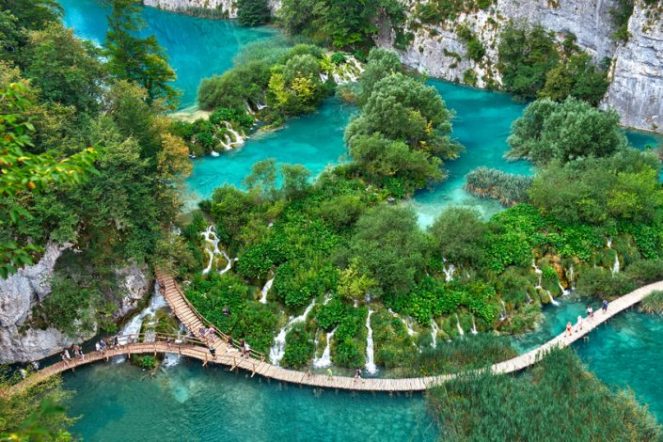
A few years ago, my brother told me about a national park in Croatia. He showed me some photos online and I could not believe that a place like Plitvice Lakes National Park existed. From the photos it looked fake. It looked like a place where unicorns, rainbows and fairies are born. I had to see it for myself.
fullsizeoutput_b531fullsizeoutput_b537

Listed as Croatia’s most popular tourist attraction, each year more than 1 million visitors head to this UNESCO World heritage site.  Most visit in the summer, but the park is open year round and after experiencing Plitvice, I want to revisit the magic of this place in autumn. The color of the trees set against that water must be incredible.

Plitvice is located in the mountains of central Croatia, near the border with Bosnia and Herzegovina, and, between Croatian capital city Zagreb and Zadar.  We purposefully chose the Dalmatian region for our trip due to its central location to a number of national parks that we wanted to explore. Pltivice was the last park we visited at the end of our stay and we almost didn’t make it. I am so glad that we made the time. The park is a must-see destination in Croatia.

The park is made up of a series of cascading lakes which result from several small rivers flowing into one another. Fortunately, due to the protections provided by its UNESCO World Heritage Site designation, Plitvice has been allowed to flourish and maintain its natural Garden of Eden-esque status. The topography is varied. The flora and fauna, lush.

The origin of the name Plitvice has two incarnations. One version states that a priest named Dominik Vukasović, named the lakes pličina or plitvak, meaning shallow, because the lakes were formed by river water flowing and shaping shallow travertine basins  over time.

Another version of the name stems from the fact that the river Plitvica and the adjacent village of the same name gave origin to the name. It seems most logical to me that the 2 stories are both true. The name may have come from the Croatian word for shallow and then the river and village took on the same name given their proximity. What is interesting, however, is that reference to “shallow” may not be apropos forever. The travertine basins are living entities consisting of bacteria, algae, sediment and minerals which, much like coral in the oceans, are growing continuously. The travertine accumulates and grows at a rate of about 1 cm (0.4 in) per year. Ok, so maybe the “shallow” moniker still stands, but over time the entire area is growing which I find fascinating.

Things To Do
Plitvice has something to offer every outdoor enthusiast. One can leisurely stroll along the planked walkways, hike, boat, canyon climb, cycle or ski and sled in the winter.  The only thing one is not allowed to do at Plitvice, is swim. Sorry to you swimmers out there, but there’s no swimming allowed because of the need to protect the travertine and the plant and animal life which makes the places so enchanting . If you must get as close to the gorgeous water as you can,  small row boats are available to rent for 50kn/hour (7 euros or 8 US dollars ).  You can also take a ride on an electric boat to the 12 upper and 4 lower lakes. The electric boat rides are included with your admission ticket.

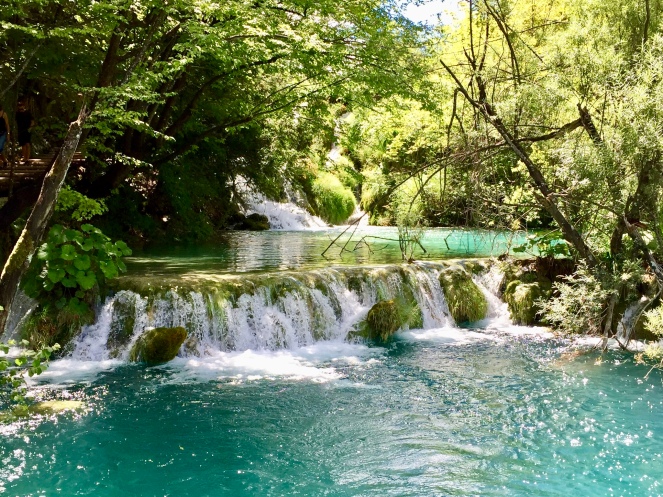
There are approximately 300 square kilometers, forest trails, 16 lakes, limestone canyons and waterfalls to explore.  There were so many waterfalls that we lost count.  Many people spend a few days at Plitvice, and there are plenty of accommodation choices available – everything from luxury lodging to camping. Sadly, we were only able to carve out a day trip from Zadar.

Things Not To Do
When visiting the park, it is critical to know that one cannot:

  • Collect plant materials or take any “souvenirs” of natural origin
  • Feed, disturb, touch the animals
  • Swim in the lakes (that part is the most disappointing as it was hot as Hades and the water looks sooooooo inviting).
  • Throw litter along the trails or elsewhere, except in the garbage bins installed throughout the park. It is shocking that this is even something one needs to be reminded of, but . . .
  • Stray off of the marked trails
  • Fish
  • Yell or be loud
  • Cycle or camp within the park’s borders

The Water Really Is That Color
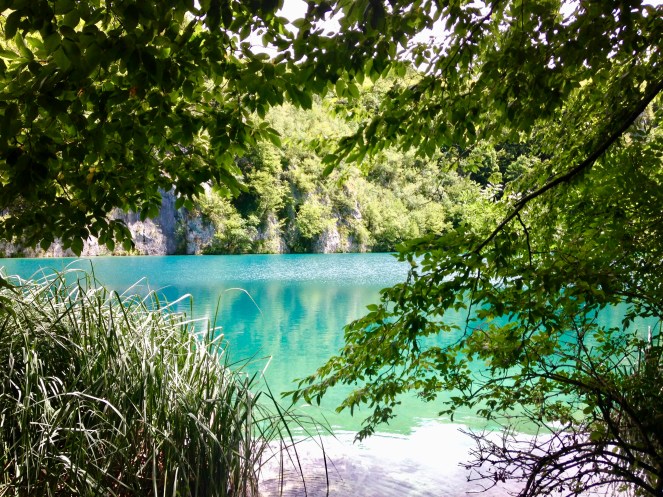
The lakes are renowned for their distinctive bright colors. And, the water color changes from emerald green, turquoise blue, and grey depending on the quantity of minerals, the number of organisms in the water, the season, and, the angle of sunlight.

We saw bright turquoise, emerald green and crystal clear streams. The fact that the water color changes at just about every turn, adds another element of otherworldliness to the place. This park had all my senses engaged and stimulated my imagination. I was imagining children’s books where the places were named for the different locations and colors. The fairies live at Emerald Lake, while the unicorns hide behind the rushing falls of Turquoise Lagoon. And, of course rainbows are made on top of Oštri Medveđak, the park’s highest peak. Silly? Maybe. The magic of Plitvice got me.

Practical Stuff
There are two entrances to the park. When planning your trip, check out the trail options before you go in order to know where to park.

We opted for Entrance 2 (South Gate and Upper lakes) as it was closer to the waterfalls that I wanted to see. When visiting, be advised, the park is crowded, the walkways are simple uneven wooden planks with no railings. I cannot tell you the number of times I almost was jostled into the water. Advice, take a waterproof camera and/or phone case for your smartphone in case of an accidental fall into the water.

From entrance 2, there are 4 trail options to suit every level of difficulty and time.

  • Trail E (2-3 hours – 5.2 km – easy) upper lakes to Proscansko Jezero starting with a short boat ride across the Kozjak Lake.
  • Trail F (3-4 hours – 4.6km – easy) walk the upper lakes and sail across lake Kozjaka, then visit the lower lakes – take shuttle back
  • Trail H (4-6 hours – 8.9km – moderate) starts with a bus ride to your starting point, walk the upper lakes then sail across lake Kozjaka, to the lower lakes – take shuttle bus back.
  • Trail K-2 (6-8 hours – 18.3km -difficult) like Trail K-1 – explore the whole park.

Another option if you are looking for a moderate hike, is Trail C from Entrance No 1. This path starts with an uphill climb and allows you to see both lakes. A stop at the upper lakes is also a perfect spot to rest, drink some water and enjoy a picnic.

If you go in the summer, try arrive early as it gets VERY crowded.  We were told that the majority of tour busses usually arrive between 11:30 – 12:30.  If you get there early enough, you can avoid the majority of the tour bus crowds.  Another option for a visit during the summer, is to arrive in the afternoon when most tour groups have finished their guided walks. Summer days are long with light and a peaceful afternoon in Plitvice would be heavenly.

I would also recommend packing a lunch. We made the mistake of not bringing food and were disappointed with our options. The food inside the park is bland, overpriced and poor quality. It would have been much nicer to have had a nice picnic overlooking this:
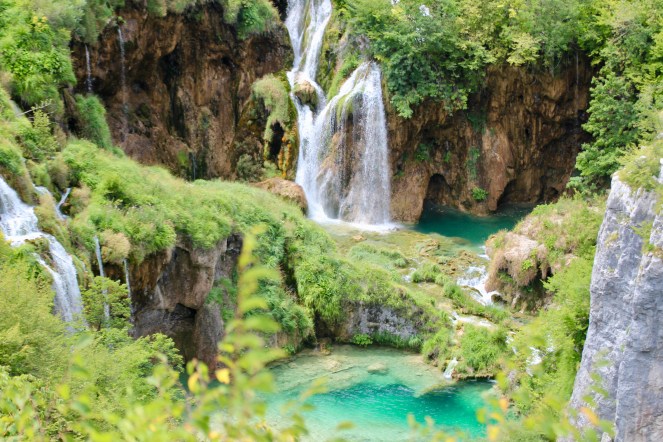
fullsizeoutput_b520

My family loved everything about Croatia, but Plitvice was definitely one of the highlights. If you visit Croatia, you simply must visit Plitvice. And, please, let me know if you spot any fairies, unicorns or rainbows.

Americans abroad · art · Copenhagen Denmark · Denmark · European travel · ex-pat life · international travel · Malmo Sweden · Modern Art · Travel

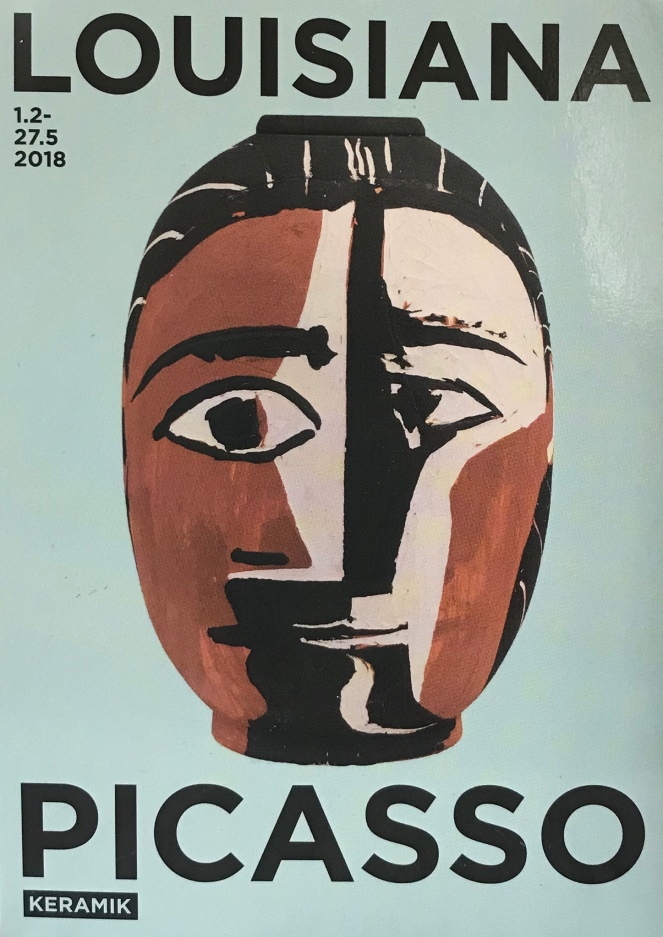
Sun, Sea & Picasso – The First Day of Spring at The Louisiana Museum of Modern Art

We here in Scandinavia have had an unusually long winter – 5 1/2 months to be precise. 5 1/2 months of snow, sleet, rain, cold grey days.  This weekend the spell was broken, however. It was sunny at last. A proper spring day with sun and a chill in the air. All day I kept hearing the Beatles refrain in my head , “Here comes the sun . . .”

In honor of the lovely first day of spring we headed to one of our favorite indoor/outdoor spaces – The Lousiania Museum of Modern Art in Humlebæk, Denmark.

The museum sits on a bluff overlooking the Öresund Strait and enjoys sweeping lawns with an incredible display of sculpture, trees, flowers, sea breezes. Just visiting the grounds are worth it, but then there is the museum itself. Architecturally, the museum structure and grounds evoke Frank Lloyd Wright and his philosophy of bringing nature into the building. The museum is designed with lots of big windows whose function it is to bring nature inside the museum walls. It is a space that simply makes one feel calm, peaceful and good.


The grounds have sculptures scattered throughout. The sculptures are not placed haphazardly, however. The sculptures are specifically positioned in order to interact with the architecture and nature that surround them. The placements are precise and are designed to allow visitors to enjoy a different experience with each visit depending on the weather and the season.

We would have been happy just enjoying the sun and sea that day, but imagine our surprise when we arrived and discovered that there was a Picasso ceramics exhibit going on. This particular exhibit was named one of the top exhibits to see in 2018 by the New York Times and it does not disappoint.

fullsizeoutput_b40b.jpeg

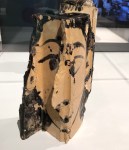
In fact, it was stunning. One of the things I have always loved about Picasso is that his work is so dynamic and prolific –  his work encompasses traditional paintings, the cubists phase, sculpture and then his colorful, whimsical ceramics.  There are over 160 pieces on display and a lovely film offered with English subtitles about this particular creative period in Picasso’s life.

Picasso’s interest in ceramics began in the summer of 1946 when he attended an exhibition in Vallauris, France, an area known for making ceramics since Roman times. After WWII, and at at the height of his success, Picasso returned to Vallauris seeking new artistic experiences. The war had worn him down emotionally and he sought new challenges and inspiration artistically.  In this last period of his life he began to pick up clay and he immediately began experimenting with the materials, glazing techniques and processes. Apparently, Pcasso loved how unpredictable the firing process was on the clay and he enjoyed the resulting surprise of colors that emerged.

All in all, it is estimated that Picasso produced over 4,000 cera­mic objects during this time. It is said that one of the things that inspired him to create ceramics was the desire to put art in the hands and lives of the common man.  By turning utility objects like a platter or a water pitcher into an art piece, it allowed art to enter the every day world. So dedicated to the concept of making art available to all, Picasso created a line of work called Edition Picasso which were created specifically to be affordable. Picasso essentially served as the designer and allowed a ceramic workshop in Madoura, France to actually replicate each piece. This was one of the first (if not the first) times in art history that copies were mass produced based on an original work.  Picasso’s confidants advised him against this idea warning him that the practice would devalue his other works. Picasso soldiered on with the idea and from 1947 – 1971 he designed over 600 editions for the collection. And while initially affordable, once the artist died, the Edition Picasso ceramics went steadily up in price and did no damage at all to the value of Picasso’s other works.


If you are in the Copenhagen area and are looking for a unique museum experience as well as an outstanding collection of art, I highly recommend the Louisiana Museum of Modern Art. And if you are not in the area just now, keep a look out for the Picasso ceramic exhibit coming to a museum near you. You will not be disappointed.

Americans abroad · European travel · ex-pat life · Giethoorn · Holland · international travel · The Netherlands · Travel

The Fairytale Town of Giethoorn, Holland.

Need a city break?
A break from the hustle, bustle and noise of a city? Then head over to Giethoorn, Holland, the picturesque village free from car traffic. Giethoorn is known for its many canals and in the spring and summer, for its colorful flowers. Even in the dead of winter, though, Giethorn will win you over with its charms, namely, its peaceful nature, the charming cottages, the many beautiful boats and the numerous wooden bridges.

This car free village can be seen one of three ways; by boat, foot or bike. Named the Venice of Holland, Giethoorn is a labyrinth of canals. In fact, the village is so dependent on its waterways, that many of the houses cannot be reached by road and the postal service delivers the mail by boat. How cute is that?

Early History of Giethoorn
Located in the municipality of Steenwijkerland, Giethoorn was settled in the 1200’s when refugees  (some say fugitives) from Perugia, Italy founded the village looking for a new place to farm. The land was not conducive to farming however, as it was swampy and damp. While attempting to farm their fields, the settlers unearthed large quantities of goat horns. Yes, goat horns.  These horns were assumed to be the archeological remains of wild goats that drowned in the All Saint’s Flood of 1170. The villagers then began calling the village “Geytenhoren” which eventually became Dutchified in its present form of Giethoorn.

The marshland, while not ideal for farming, was a great source of peat moss which was burned as both a heating source for homes as well as for fires to cook over. It was also used as roofing material to insulate houses. The early villagers began peat mining with gusto and discovered the best way to move the harvested peat around was on the water. Canals were dug for transportation and the town became dedicated to water transportation.

Today the charming brick cottages are still adorned with peat moss thatched roofs and shiny black, forest green or red shutters. The thatched roofs add to the overall charm of the village, evoke days gone by and keep the tourists coming back, however, while originally the thatched roofs were the result of cheap and plentiful peat moss, today, maintaining the thatched roofs is no longer an inexpensive alternative. The roofs cost 150 euros a square meter and need consistent attention due to weather.

Home to less than 3000 people, Giethoorn is a quiet community with four miles of canals. Many of the residents live on private islands with their main means of transportation are with a canoe, kayak, punts or whisper boats (so named for their silent motor that does not disrupt the tranquility). Homeowners with cars park outside the village in a specially designated lot and then use punt boats to get around. One can also traverse the town on a bike or by foot.

The tranquility, coupled with the beautiful homes, the bridges and in the spring and summer, the flowers, make any journey through the Dutch Venice, unforgettable. One feels peaceful and calm while visiting this unique village. At times, the only noise you may hear are the calls of the local birds. Even the boats have been designed to make as little noise as possible. A visit to Giethoorn is about as close to a natural church setting as one can get.

Getting There and Getting Around
Giethoorn is 55 miles northeast of Amsterdam.  You can reach this amazing village via car or train from the city of Amsterdam. If you drive you will be required to park your vehicle near the village centre then walk to the port area where you can rent a whisper boat, a kayak, a punt or take a guided canal tour. The village is small and there are plenty of signs pointing you in the right direction.

It was cold when we visited so we opted to take a covered, guided canal tour that comes with a hot cup of coffee, tea or coco.  Not only were we warm, but we learned the history of the town. I highly recommend the guided canal tour.

If you decide to walk or bike, note that there are approximately 180 wooden bridges connecting the town. For some home owners, the bridges are the only way for them to connect to the rest of the town. 

If we had visited in the summer, I think I would have enjoyed exploration by bicycle. Giethoorn, true to its Dutch heritage, has extensive bike paths throughout the town. After cycling around the canals, one can also cycle around Lake Bovenwiljde and experience the Dutch countryside, complete with farm animals, wildflowers and windmills. There are a number of affordable bike rental places. As we did not rent bikes, I cannot recommend a specific company, however, we were told good things about these guys.

Explore
If you explore Giethoorn by bike or foot you will also discover the many cafes, art galleries and churches tucked into little corners that are not as accessible by boat. From our boat we saw many that I vowed to visit again in warmer months.

There are 2 museums worth nothing as well. The Het Olde Maat Uus Museum takes visitors back to the time when the village was founded and one can experience typical Dutch farm life from years gone by – complete with cooking outside of the house in a special cooking hut. The thatched roofs made cooing indoors too dangerous, so the cooks were relegated to a separate cooking house. Many cooking huts are still on the properties and are visible when touring around.

And, if geology is your thing, you can visit De Oude Arde which touts a large display of rocks.

I, for one, plan on returning to Giethoorn when the weather is better. I want to ride a bike around the village, past the adorable thatched roofed cottages, over the wooden bridges past glorious, colorful  flowers, past the lake and out to the Dutch countryside where I will throw down a blanket and lay out a picnic.

I hope you are able to experience the charm of this quaint Dutch village one day too.

Americans abroad · European travel · ex-pat life · international travel · Italian food · Italy

Mangia, Mangia!

Photo by Getty Images

“Watching Italians eat (especially men, I have to say) is a form of tourism the books don’t tell you about. They close their eyes, raise their eyebrows into accent marks, and make sounds of acute appreciation. It’s fairly sexy. Of course I don’t know how these men behave at home, if they help with the cooking or are vain and boorish and mistreat their wives. I realized Mediterranean cultures have their issues. Fine, don’t burst my bubble. I didn’t want to marry these guys, I just wanted to watch.”
― Barbara KingsolverAnimal, Vegetable, Miracle: A Year of Food Life

Americans abroad · Emilia Romagna · Italian food · Italy · Parma Italy · parmigiano-reggiano · Prosciutto di Parma

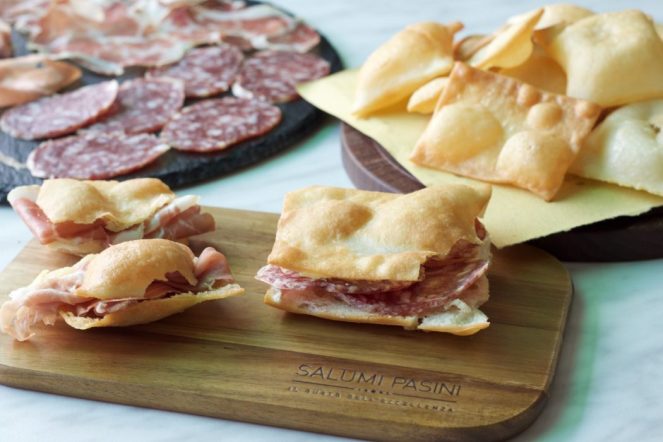
Torta Fritta

Torta Fritta
Torta Fritta

One day, not long ago, I was craving this yummy little treat from the Emilia Romagna region of Italy. Torta Fritta as it is known in Parma or Gnocco Fritto if you are in the next town over because in Italy food is very regional and even if it is the exact same dish but it is in the next town it must have a different name.  Oh Italy, I do miss you.

Anyway, there I was in Sweden dreaming of Torta Fritta. Torta Fritta are little pillows of dough, lightly fried and puffed up. They are most often served warm and stuffed with Parmesan cheese, Prosciutto di Parma, salami and various meats. They are little pillows of culinary heaven.

The thought never entered my mind to make them from scratch, because, you know, I am not Italian and Italian cuisine (real Italian cuisine not the over worked American versions) is intimidating. So I foolishly tried to Macgyver it and I bought some pre-made, albeit fresh, pasta with the intention of flash frying it into pillows. It didn’t work. It wasn’t pretty. And it certainly wasn’t Torta Fritta.

What I forgot is that while living in Italy I discovered that most Italian recipes are actually quite simple. They pair a few ingredients that happen to compliment each other. They don’t over work, they don’t add too much. They let the flavors meld and do all the work. Then I remembered that one of my favorite gifts that I received when moving from Parma was a cookbook given to me by my gem of a friend, the amazing Beatrice Zambelloni Papoccia. Bea is the Martha Stewart of Italy and one of the best cooks I have ever had the pleasure of tasting. She gave me a book titled Ten True Gems of Parmesan Cuisine. I cautiously opened it, searched for the recipe and said a little prayer to Don Alfonso.

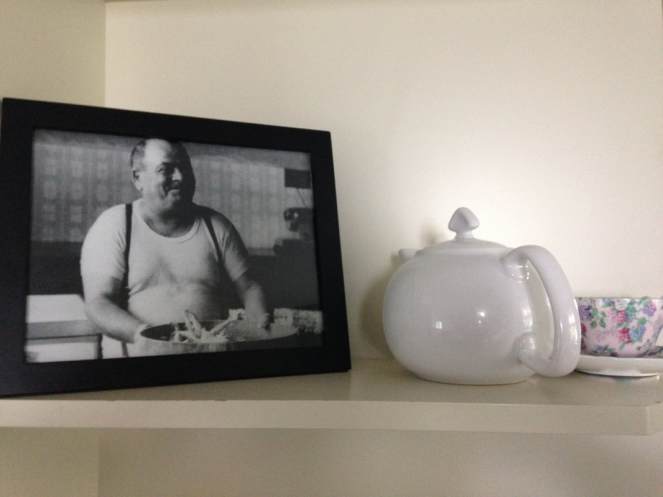
Sidebar – Don Alfonso was the original proprietor of our favorite restaurant in Parma and the staff was kind enough to give me a commemorative photo of Don Alfonso when we moved. He sits on a shelf in my kitchen overseeing it all, and I like to believe, spreading good Italian food mojo around the kitchen.

torta fritta
The Don, overseeing it all.

I opened the cookbook and there it was. The recipe.

And here it is for you now:

​Torta Fritta – enough for 6

1/2 a kilo of white flour
water
salt

Mix the ingredients, adding enough water to obtain a rather soft dough. Roll out the dough to a thickness of 1/2 a centimeter. Cut it into rhomboids with a pasta cutter. Fry the pieces in oil or lard. Torta Fritta can be served hot with cheese and meat and if there happens to be any leftover, ​it is excellent eaten cold the next day, dipped into milky coffee or with jam.

I know what you are thinking. I know that you are judging me because it is soooo easy, but let me tell you when you have tasted fresh Torta Fritta that has been handmade by your neighbor’s nonna it tastes complicated. I also know that you want to know the precise measurements of the water and salt but this recipe has been handed down for hundreds of years and you will just have to work it out.

Finally, just because I am American, if you want to complicate the recipe, I read that sometimes, a drop of milk is added to soften the dough.

Buon appetito tutti!

Americans abroad · Bologna Italy · Emilia Romagna · ex-pat life · Italian food · Italy · Parma Italy

Cappelletti in Brodo

Cappelletti in Brodo  is a lovely Italian soup. This soup so simple, but packed with flavor and is popular in Italy during the winter months. It is also a staple of the Italian Christmas menu.

Cappelletti – little hats – are similar to tortellini. They are not tortellini though.  Cappelletti are made with squares of pasta rather than the circles used for tortellini. The squares are folded in half to make a triangle, then the two ends of the triangle are joined together to make a turned-up peak, which make them resemble the tri-cornered hat of the Italian army.  So, the top point is up for cappelletti or folded down for tortellini.

This is so simple it is a wonder that I never thought of it when living in the USA.  I also never saw it served anywhere in the USA.

If you are so inclined as to make the cappelletti from scratch, the recipe is below.

If you are short on time however, you can buy freshly made cappelletti and use a homemade broth. I recommend that the cappelletti is fresh though.

Cappelletti can be filled with meat, poultry or ricotta cheese.


For the Broth
The broth will vary according to your filling. For example, if you are filling the cappelletti with meat you will want a beef or pork based broth. If you are filling them with poultry, then make a chicken stock. If you are filling them with ricotta cheese, the broth base can be either meat or poultry based.

Here is a standard chicken based stock recipe.

1 whole chicken in pieces
1 tomato
2 stalks of celery, in chunks
2 carrots, chopped in chunks
2 large onions, chopped in chunkssprig of parsley
healthy pinch of salt
water

In a large stock pot add all ingredients and cover with water.Bring to a boil.
Lower the heat and simmer for 3-4 hours.
Strain your stock and discard the vegetables.

Pick the meat off the bone to use in the cappelletti.  Substitute beef and/or pork for a different filling and stock.

For the Pasta
You will need a pasta machine. You can get a pasta machine online for as little as $25.00. Using a pasta machine also helps to create a silky smooth pasta.

Before you begin, take your eggs out of the fridge and let them come to room temperature.

You will need:
3 eggs plus 1 egg yoke
3 cups of doppio zero “00″ flour if you can find it.  If not, you can use all-purpose flour, but try “00″ if you can get it. It is different than the flour typically used in the USA.
Pinch of salt

Put the flour in a large bowl and make a well in the center. Add the eggs and salt to the well and mix gently with a spatula. Slowly incorporate the flour. Mix in the remaining flour and place on a lightly floured counter. Knead for 10 minutes. The dough will soften up after it rests. Cut the dough in half and wrap each half in a damp cloth. Let the dough rest for one hour.

After the dough has rested:
Unwrap one of the dough pieces and cut it in half, re-wrap the remaining dough.
Cut your dough in half and roll it out on a floured surface.
Put your pasta machine on setting #1. Pass the dough through each setting (1 through 5) twice.
Lay the pasta dough on flat surface and cover it so that it doesn’t dry out as you put the remaining dough through the settings.

Cut the sheets so they are 2 inches wide.
Cut the pasta the other way so that you have 2 inch squares.

For the Filling
The filling can be meat, poultry or ricotta cheese. This recipe is for a composite meat filling.

1/4 lb ground veal or pork
1/8 lb prosciutto
1/8 lb mortadella
1 cup Parmigiano-Reggiano cheese
1 egg
1 tsp butter
nutmeg, salt and pepper to taste

Brown the ground pork and set it aside to cool. In a food processor, add the mortadella and prosciutto, pulsing to mix. Add the ground pork, butter, cheese, egg and pulse some more.

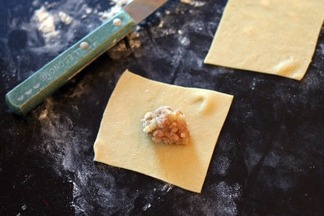
Place a little bit of filling in the center of each square.

Fold corner to corner so your square is now a triangle.

Dab a little water if you need it for the seal.

Take the two outer corners and fold them around your finger, pushing the center up.

Leave the “point” up as this is the signature of cappelletti.


Place on a lightly floured tray or wax paper. 

For the Cappelletti in Brodo

Simply bring the stock to a boil.
Add the cappelletti and cook until they bob to the surface.
Serve hot and top with shavings of Parmigiano-Reggiano cheese and some good fresh bread.

Buon appetito!

Americans abroad · Emilia Romagna · Italian food · Italy · Parma Italy

Sbrisolona – The Yummy Traditional Crumbly Italian Almond Tart

Sbrisolona
Sbrisolona

Before we officially moved to Italy, my husband brought a Sbrisolona back with him on one of his commuter trips. I instantly fell in love with it and all its almondy deliciousness.

After arriving in Italy, I took a cooking class with some friends. I was delighted to see Sbrisolona on the menu and even happier to learn how simple it is to make. Sbrisolona is perfect in the morning with an espresso or cappuccino, but also a lovely end to your meal at night with some sweet dessert wine.

The History
Created around the 16th century in the Northern Italian countryside, near Mantua, Sbrisolona was a popular dessert among poor families. In order to save money, they would prepare the tart by mixing cornmeal, hazelnuts and lard.

Although made with inexpensive ingredients, Sbrisolona began to appear on the tables of the noble families of Mantua, including the Gonzaga family.

In the noble households, the recipe was enriched with more expensive ingredients using sugar, spices and almonds, without moving too far away from the original characteristics of the dessert.

According to tradition, this hard, yet crumbly, dessert should be broken into pieces and eaten with one’s hands.

The Recipe
Preparation – 10 minutes

Cooking – 20 – 25 minutes depending on your oven

Ingredients

  • 1 ½ lb all-purpose flour
  • 1 ¼ lb butter
  • 1 lb granulated sugar
  • 4 oz egg yolks
  • ½ oz baking powder
  • lemon zest, grated
  • 1 ¾ oz almonds
  • ⅞ lb cornmeal

Method

  • Blend all ingredients together on a table or work-surface.
  • Mix all the ingredients together to obtain a pastry dough.
  • Crumble the dough into a greased pie pan.  Do not press the dough together, let it remain crumbled.  The knack lies in preparing all the ingredients by crumbling them. Do not let the mass become homogeneous.

Optional – Arrange almonds on top of the crumbled mix.

Bake in a preheated oven at 360°F for 20 -25 minutes depending on your oven.

This yummy dessert can be served at brunch, for dessert, at bookclub or at a work function. It is great with coffee or dessert wine. Versatile, light and full of flavor, it will not disappoint.

Americans abroad · Bologna Italy · Emilia Romagna · ex-pat life · Italian food · Italy · Parma Italy · parmigiano-reggiano · Prosciutto di Parma

Prosciutto With Black Truffles and Truffle Mustard Dressing

This appetizer is so simple and so full of flavor you may end up serving it at every party you have from here on out!

The Recipe

Ingredients
4 tbsp extra-virgin olive oil
3 tbsp apple cider vinegar
1 tsp truffle mustard or dijon mustard
6 thin slices fresh black truffle, finely chopped
Salt and pepper
8 small slices ciabatta
1 tbsp extra-virgin olive oil (for brushing)
4 slices prosciutto
Small salad leaves, your choice
8 thin slices of fresh black truffle

Method
Make dressing first by mixing 4 tbsp olive oil, cider vinegar, mustard and finely chopped truffl e. Season with salt and mix well. Preheat oven to 160C. Brush ciabatta bread pieces with 1 tbsp of olive oil and toast lightly in oven for 8-10 minutes.

Meanwhile, cut each prosciutto slice in half to obtain eight pieces. Once toasted, remove ciabatta pieces and, while still hot, place a piece of prosciutto on each and nestle on serving plate with small salad leaves. Drizzle with truffle dressing and finish with a truffle slice on each crostini. Add a couple of turns of pepper over the lot and serve.

Thank you to http://www.goodfood.au for the recipe.

Americans abroad · European travel · ex-pat life · Italy · Parma Italy

Your Carriage Awaits You

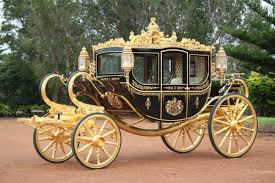
Photo by http://www.trendhunter.com

So, my husband accepted the job in Italy. We were moving and we needed a house. I have heard that moving is one of the most stressful things one can do. Add to it the challenges of an international move, and stress doesn’t adequately describe the feeling.

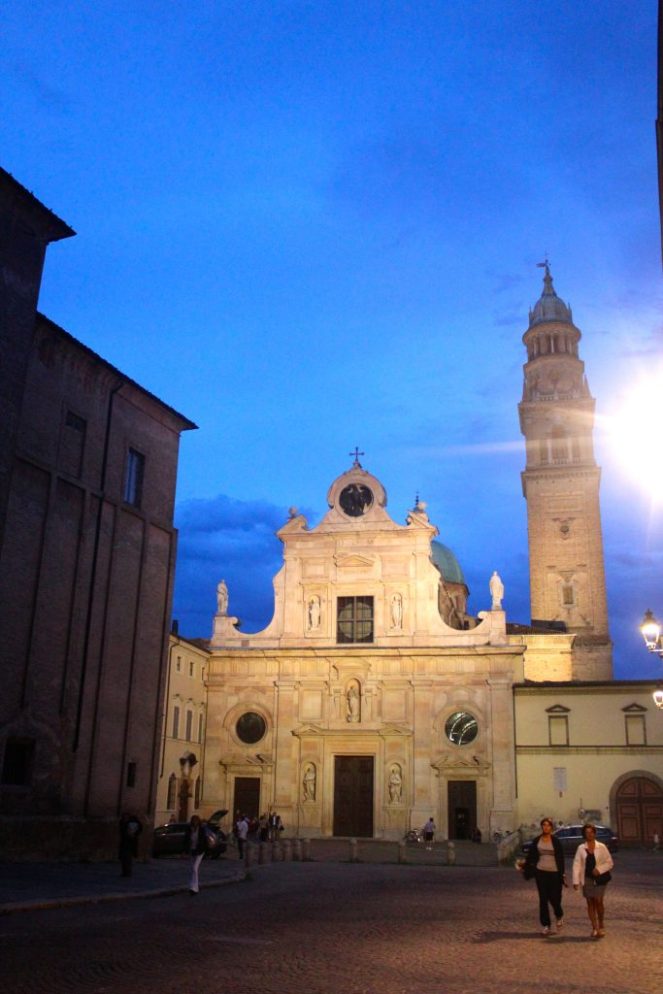
The company set up a trip for us to go house hunting in Parma. We were put up in a very nice hotel right in the center of town. We walked the narrow, cobblestoned, beautiful streets and explored our new city. The buildings were architecturally beautiful. Many had interior courtyards, carved edifices and delicate detail. Parma was gorgeous and romantic and everything that I had hoped for. I was excited.

House hunting in a foreign land is challenging. There is the language barrier and cultural expectations that must be tempered. And there is the fact that most American houses are larger than what Europeans are used to living in. Space was an issue. I had reduced our belongings by 1/3, but we still had more stuff than the average Italian family. I meticulously filled out the forms telling the relocation expert what we were looking for. Our relocation expert, Ignazio, arrived in a fancy big car to drive us around and look at houses. My excitement grew. We were driving around Parma and the buildings were just gorgeous. The countryside was stunning.
In my excitement, I asked questions, I commented on how lovely the town and the surrounding villages were. I tried to engage Ignazio. Yet, every time I made a comment, Ignazio ignored me, and when I asked a direct question, Ignazio looked at my husband and answered the question. I seemed to be invisible, although, he clearly heard me as he was answering what I had just asked?? There is a saying the USA, that a happy wife equals a happy life. Clearly, this was not an idiom in Italy, or at least not with this guy. The thing is, my husband is happy wherever. His housing needs are much simpler than mine. I wanted to find a place that would not only fit all of our stuff, but also, one that would make the kids comfortable and happy. When I walk into a space, I can envision where every piece of furniture will go and I can quickly assess if the space is big enough. Machismo Ignazio didn’t seem to realize that I was the one that he needed to please. The first few apartments and houses that he showed us were not even the right number of bedrooms. What he called a bedroom would not fit anything more than a twin bed. Where would wardrobes go?? My excitement was waning. My excitement was transitioning to worry and frustration with Ignazio. Surely, there had to be bigger spaces. It felt like there was a puzzle piece missing. His car was bigger than some of the places he showed us (ok, that may be hyperbole, but you get the idea).

After a few days of house hunting, I was near hysteria. We were running out of time and there did not seem to be anything in Parma that fit our family. Plus, Ignazio was still ignoring me and my feedback, thus, we were not making any progress. A friend in the USA hooked me up with a producer of a popular international house hunting show. They wanted us on the show. I saw angels and heard harps playing. Salvation was on the way. Uh . . . no. Spoiler alert, if you are a fan of these type of reality shows, you may not want to keep reading as I am about to burst your bubble. Pre-production called me and explained that they do not actually help you find an apartment. The show features families who have already found a place to live. They move the family completely out of their apartment, film it empty, film the family looking at a bunch of other apartments that no one really intends to rent, move them back into their apartment and film the result. “Why would anyone do that?” I asked. That process did not seem like it was going to help my stress levels. We declined the show appearance. One more trip in the big fancy car did not help either. I was no longer enjoying my first visit to Parma and I was on the verge of causing a scene at the relocation offices.

One evening, after yet another stressful and unsuccessful day of house hunting, we decided to go out for a walk and find a restaurant that the hotel had recommended. Armed with a map and American confidence, we set out. While the narrow, cobblestone streets are charming, they are also quite confusing. We got lost and the streets were empty. This was surprising for a Saturday evening. We would later figure out that we were far too early, but I digress. We went into a few shops and asked if they spoke English. No. We gave them the name of the restaurant and the map and pointed. Nope, they couldn’t help us.

So there we were. Standing in the street, tired, frustrated, running out of time to find a place to live, lost and hungry. Anyone familiar with the old Jack Lemon movie The Out of Towners? We were that couple.

Photo by The Out of Towners at IMDB.com

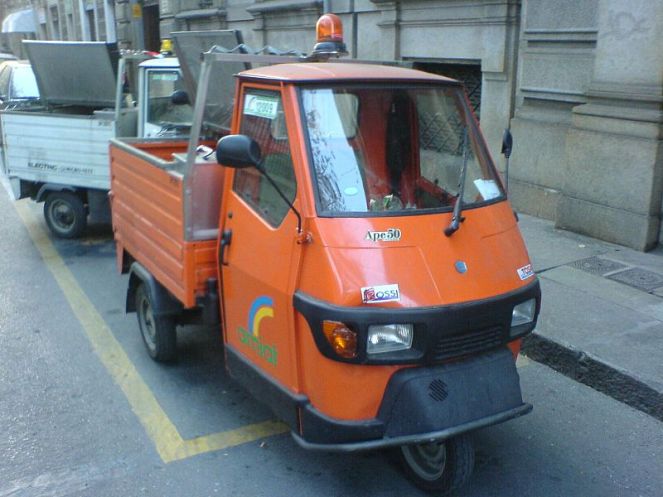
As we stood there staring at the map, tears of emotional exhaustion in my eyes, a garbage truck the size of a golf cart pulled up. A man got out and approached us. He spoke no English. He looked at our map. We showed him the name of the restaurant. He pointed in a few different directions. We were still confused. He waved his hand. We stood there with blank stares. He waved his hand again and added a head nod toward the garbage truck. “I think he wants us to go with him.” I said. “Should we? We don’t know this guy. He could drive us somewhere and murder us after stealing our wallets and jewelry. We have 2 children at home. We cannot get murdered in Italy!” We were armed with American confidence AND American fear culture, but again, I digress.

I still do not fully understand why, perhaps our sheer physical and emotional exhaustion took over, but, we decided to get in the garbage truck. The gentleman drove us around for a few minutes, picking up garbage bags that had been left on the streets. Then he delivered us to the front door of the restaurant. We thanked him effusively. He smiled and said “Niente. Buon appetito.”

Then something wonderful happened. The stress dissipated and my husband and I started laughing. In the USA, a garbage truck would NEVER offer to drive you anywhere – liability and union rules. Nor would we ever agree to get in a garbage truck with a perfect stranger. Too scary. But here in our new country, the garbage truck was a sign. Here, in our new country, we were going to have to learn to adapt. We were going to have to accept that the best apartment may not be the size of the house we left behind.  We were going to have to embrace the changes, the stress, the new rules, and, the adventure of it all. We were going to have to learn to recognize that sometimes the most beautiful carriage is not a big fancy car, but a golf cart sized garbage truck.

Photo by Piaggio_Ape50_clean_machine
Americans abroad · Bologna Italy · Emilia Romagna · European travel · ex-pat life · Firenze Italia · Florence Italy · international travel · Italy · Parma Italy · Travel

La Bella Figura

“The Creator made Italy from designs by Michaelangelo.”
Mark Twain

lbf1

This is the quintessential Italian woman. Elegant, stylish, understated and fare la bella figura.

Fare la bella figura” literally means “to make a beautiful figure.” The phrase refers to the Italian ideal of looking your best at all times. For this casual Californian this ideal may be the biggest challenge that I’ve faced living in Italy.

Northern Italy is the home of Milano, the seat of fashion houses and world famous designers. People are stylish here.  Then, among Italians, Parma is known to be a very fashion conscious community.

The first week of school, I was jet lagged and coming down off of an emotional roller coaster of a year.  I was unaccustomed to humidity and was sopping wet every time I stepped outside.  Because of the humidity I was also carrying around water, which I stated earlier is a big no-no.  So there I am the first day of school in Italy, bedraggled, exhausted and definitely not stylish. I hardly felt the need to dress up for the ten minute walk to school when I was just going home to unpack dirty, dusty boxes.  I was feeling good about myself because I had put on some makeup and my fancy Taryn Rose flip flops.

I arrived at school, looked at all the Italian mothers and thought “uh oh.”  Not only were they thin and beautiful, they all looked very stylish in an understated, elegant way. Northern Italian women don’t wear a lot of makeup. They don simple, but high quality and finely tailored clothes. They wear dresses, skirts and lots and lots of stilettos. And boots – year round. And scarves – year round.  I stood on the sidewalk, hair in a ponytail in casual, (almost exercise) clothes. Needless to say, I stood out like a sore thumb.

I had a conversation with my friend Diana who is English about the Italian women’s seemingly effortless style. Diana noted that if you went to the supermarket in England dressed like an Italian woman does, everyone would think, “what is she trying to prove?”  I thought about how people would react if you showed up at Safeway in stilettos, a dress, a scarf – Diana was right.  Americans too would think you were putting on airs. The only reason you would wear high heels to the supermarket in America was if you were on your way to or from work or an event. In Italy, however, it a common occurrence.

From my American (and casual Californian) perspective, it seems like a lot of work to get dressed up just to run to the supermarket, go to the gym or walk the kids to school. But dress up they do. I was no longer in California and if I didn’t want to stand out I was going to have to make some changes. Wearing exercise clothes on the street is just not done here and flip flops (my shoe of choice in California) are reserved for the pool or the health club.  If I continued my disregard for la bella figura, I may offend someone or at the very least confuse them.  My American friend Sarah told me that once she went out in her “tuta” or her exercise suit with no makeup. She ran into her landlady who promptly contacted Sarah’s Italian in-laws to inquire if Sarah was feeling ill since she had been out of the house looking so casual.  In Italy, being ill is the only excuse for failing fare la bella figura.

The first week here I sat back and observed. I saw one woman ride up to school on her bicycle in a tight pencil skirt, gorgeous blouse and stilettos. There was a light summer rain. She rode her bicycle while holding an umbrella, one child on the back of her bike and another in the front.  She arrived, floated off of her bike, got the kids out of their seats, grabbed her Louis Vuitton bag and glided into school. Not a hair out of place. I watched – mouth agape. She couldn’t be a real mother of two small children. She looked like a super model. I looked around for a film crew. This had to be fake.

I soon came to accept that not only are Italian women stylish, they don’t seem to be affected by weather. Italian women’s hair is never out of place. The weather reeks havoc on my style regularly. In the summer the humidity leaves my body and head wet and it renders my hair a wet, frizzy, wonky mess. In the spring, the pollen makes my eyes water and my nose run constantly leaving me looking like W.C. Fields. The wet winter rain and fog makes my eyes water resulting in black raccoon eyes from runny mascara. And again, my hair becomes a frizzy wonky mess. Why don’t Italian women suffer as I do? Is it genetics? How do they do it?

Fare la bella figura is not limited to young women either.  I have seen many an old women dottering along, holding on to her companion for support in stilettos! Stilettos!  They can barely walk anymore, but damn it if they aren’t going to look good. I can no longer navigate a flat surface in high heels, let alone the cobblestones. The older women also love their hats, fur coats, scarves and handbags. I particularly like to watch the older ladies during the Christmas season as Italians dress up to do their Christmas shopping. At the beginning of December, the older Italian women put on their finest attire as they stroll around the main piazza and shopping streets showing off their coats, hats and handbags  It is a far different atmosphere than the images you see of people clawing and fighting over items at WalMart.  This is slow deliberate shopping experience.  Another difference between Italy and the USA, no one in Italy is afraid of PETA.. Fur and leather abound, particularly among the older crowd. Fur hats, fur coats, fur trimmed scarves, fur lined leather gloves, fur lined leather boots, leather pants and leather skirts are commonplace.

The Italian women are not alone in pursuing la bella figura. Italian men spend an equal amount of time on their appearance. Italian men’s clothes are often tailored. It is unusual to see baggy clothes on men here. Italian men also wear sweaters quite a bit. Not just pullover sweaters, but cardigans. And they like to roll up the cuffs of their pants, jeans, shorts.  Italian men also wear scarves as often as women do and they pay a lot of attention to their shoes. They also carry bags made of beautiful leather – or what we would call a man purse, a murse. Older men frequently wear suits, bow ties, fedoras and a scarf. They dress this way all the time – just to go to the post office or the vegetable market.  And where the Italian women tend to be understated, Italian men have a flare for bold style. They are not afraid to wear colors and patterns. Lord knows they love a brightly colored pant.

I have observed the Parmigiani women for almost three years now. I still don’t fully understand how they pull it off. They make being stylish and elegant look effortless and easy.  I will never understand how they navigate cobblestones in stilettos. After 2.5 years it still seems like a lot of work just to run your errands, but it is part of the Italian culture. And it is expected. And now I have come to appreciate it. The attention to style makes one feel a bit better when you are out and about. And it makes for great people watching.

The Italian author Beppe Severgnini summed it up best.  “Being Italian is a full-time job. We never forget who we are, and we have fun confusing anyone who is looking on.”

============================================================

Below are some photos of Italian stye. These are not my photos. I got these off of the internet, but I assure you that I have seen some version of each of these outfits on a regular basis.

This slideshow requires JavaScript.