Adventure travel · Americans abroad · aperitivo · art · Beauty Essentials · Bologna Italy · Bosnia Herzegovina · celebrity travel tips · Christmas cocktails · cocktails · Color Street · concierge · Copenhagen Denmark · Croatia · Dalsland · Denmark · Emilia Romagna · Emilia Romagna · European Christmas Markets · European travel · ex-pat life · ex-pat reality · favorite recipes · fika · Firenze Italia · Florence Italy · food · France · Göteborg Sweden · Germany · Giethoorn · Gothenburg Sweden · Hamburg · Helsingborg · Holland · Honeymoon travel · Insider Tips · international travel · Italian cocktails · Italian food · Italian recipes · Italy · Krka · laundry · Liebster Award · luxury travel · Maastricht · Malmö · Malmo Sweden · Modern Art · Mostar · mysig · national parks · nature · Off The Beaten Path · Paris · Parma Italy · parmigiano-reggiano · pastel de nata · Plitvice Lakes · Poland · Portugal · Prosciutto di Parma · restaurants · Saturnia · Skåne · Skåne Sweden · spa · Spain · The Netherlands · The Private Suite · The Unique and Unusual · Thermal baths · Tourettes-Sur-Loup · Travel · travel safety · Tuscany · UNESCO World Heritage Site · USA · Wadden Sea

The Liebster Award!

Niche Travel Design has been nominated for The Liebster Award!

I was nominated by A World in Reach for this peer award. For a somewhat new blogger like me, this is a special treat.  It’s always a great feeling to be recognized by your peers. Thank you, Sydney and A World in Reach.

What is the Liebster Award?

The Liebster Award is a peer to peer award, given to bloggers, by bloggers as a way to foster collaboration and support. What a nice idea.

I noticed a message board in my German friend’s house that said “liebe und respekt.”  I asked what liebe or liebster meant.  She told me it means dearest or kindest. Thus, bloggers being dear and kind to one another. This is an award I can get behind. I am always seeking advice from others and I am happy to promote the idea of collaboration. I strongly believe in the theory that what you give comes back to you.  

The Rules of Engagement

Once you’re nominated with the Liebster Award, you have to follow a few rules to celebrate your win and spread the award throughout the blogging community.

1. Thank the person who nominated you, and put a link to their blog on your blog.

2. Display the award on your blog.

3. Write a small post about what makes you passionate about blog posting.

4. Provide 10 random facts about yourself.

5. Answer the questions from your nominator and provide a fresh set of questions for those you nominate.

6. Nominate 5 – 10 blogs that you feel would enjoy blogging about this award.

7. List these rules in your post.

How I Began My Blogging Journey

I began blogging when I first moved from California to Parma, Italy in 2011.

When my daughter was a toddler she frequently made up words that sounded similar to the adult versions. She would say strawbellies instead of strawberries; froggy instead of foggy. One of the words she transposed was Parmesan. In her toddler mind, Parmesan cheese was Purple John cheese. For years our family asked each other to pass the Purple John cheese at the dinner table.

Imagine our surprise when we realized that we were moving to Parma, Italy – the birthplace of Purple John cheese.  Apparently, the universe has a sense of humor. It seemed like serendipity. What we did not know is that an international move is difficult. Life in another country is difficult. It is not all adventure.  I had 2 very sad children who did not want to move and leave the comfort of their home.

[dropshadowbox align=”none” effect=”lifted-both” width=”auto” height=”” background_color=”#ffffff” border_width=”1″ border_color=”#dddddd” ]Read about the reality of an international move here.[/dropshadowbox]

All that being said, life in Italy was often quite funny because things were soooo different than what we were used to. Thus, my original blog, Purple John, began by me just telling friends about the difficulties and the funny stories that we encountered along the way.

[dropshadowbox align=”none” effect=”lifted-both” width=”auto” height=”” background_color=”#ffffff” border_width=”1″ border_color=”#dddddd” ]Read funny stories about life in Italy in the drop-down menu here. [/dropshadowbox]

And of course, just when we were settled into life in Italy, the universe struck again and we had a second move to Malmö, Sweden. Once we moved and settled into Malmö, I toyed with the idea of reworking my past experience as a travel consultant and incorporating the blog as part of the business. The kids were older and they did not need me as much as they did in Italy. This last year I began my existing blog Niche Travel Design using my name and domain name from the travel business that I ran in the USA. So now my travel business has a blog attached to it.

My blog still occasionally includes funny ex-pat tales of excitement and woe, but now I am more focused on the business of travel. The funny thing, though . . . that little toddler that inspired my first blog name, she now works with me on the business.

At Niche Travel Design, our philosophy is that designing the perfect vacation is as much an art form as designing a home’s interior or a garden’s landscape. We curate a unique experience for each of our clients. 

We are experts in finding the best cup of coffee, the most interesting art gallery, the best place to sip Prosecco while watching the sunset, and the best accessories to make your adventure more comfortable.

Niche Travel Design is more than a travel blog. We are a community featuring stories of life abroad, cultural experiences, recipes, ideas, and tips for creating unique memories to last a lifetime. We also recommend products and services.

10 Random Things About Me

  1. I once sort of crashed a funeral. My friend was supposed to go and I was staying with her so I went too because it was celebrity filled. In the end, I felt like a heel and a looky-loo. People (even celebrities) were grieving. I don’t recommend it. Not my best moment.
  2. I always top off my gasoline, despite the warnings.
  3. I love Gene Kelly movies and I got to meet him once and had a conversation with him about his more obscure movies. It was amazing and he was so kind.
  4. I am secretly a Carpenters fan. I guess it is not a secret anymore. 
  5. I sing all the time in public even though I really shouldn’t.
  6. I once got into a car accident on the way home from a car accident and neither one was my fault. I know you don’t believe me, but it is true.
  7. Apparently, according to my family, I say Google incorrectly? Who knew?
  8. I hate, I mean really hate, The Pillsbury Doughboy. His voice makes my skin crawl.
  9. I once stayed at a “pensione” in Barcelona that was actually the host’s children’s room. He was clearing toys out of their bedroom. It was weird, but it was late and there was a train strike so I paid to sleep in a stranger’s kid’s bed.
  10. I generally don’t like chick flicks despite being a chick. I seem to be missing a gene or something.

A World In Reach’s Questions For Me

What is the most important lesson you’ve learned during your travels? That once one strips away all the cultural differences, we are all the same. We all just want safety, family, friends, love, and respect in our lives.

What’s your favorite part of traveling? Exploring and learning about a place. Finding off the beaten path things to do. I am a researcher and enjoy the discovery of new things to do, a great local restaurant, a specialty shop, an unusual experience in a typical tourist spot. Least favorite? The getting there bit. The airports, etc.  Ugh.

Do you collect any souvenirs from your travels? I used to collect art from each place but now I have too much. I had to stop. No more room to hang anything. We have also always collected ornaments for our Christmas tree. It is nice to remember our trips as we put up each ornament every year. Now I collect photographs and memories.

What is the most unique experience you’ve had with a local while traveling? Swimming with horses in Croatia. Just incredible.

[dropshadowbox align=”none” effect=”lifted-both” width=”auto” height=”” background_color=”#ffffff” border_width=”1″ border_color=”#dddddd” ]Read more about swimming with horses here. [/dropshadowbox]

If you could travel with one person you’ve never traveled with before, who would it be? Barack Obama. He is intelligent, funny, has done some cool stuff and met a bunch of interesting people. I’ll bet he has good stories. Plus, he gets V.I.P. treatment and if we were traveling together I’d get V.I.P. treatment too.  

How did you come up with your blog name? It was the name of my travel business in the USA. I focus on niche, unique, unusual travel experiences. I curate and design your trip for you.

What tip would you give to a new blogger? Learn all the technical stuff before you begin.

Is there a book or a movie that has inspired your wanderlust?  No. My wanderlust was developed as a child. Actually, I feel like it has always been there. 

What are the top 3 things on your bucket list? Africa – all of it!  Australia/New Zealand and Asia.

What is your biggest travel regret? I had a chance to go to Africa for a summer. I didn’t go because it wasn’t practical. I should have gone.

My Nominations for The Liebster Award

I have really enjoyed the Liebster Award process. I also enjoyed reading about each of these bloggers that I am nominating. I hope that you each take the time to read up on what they have to offer.

1. Divine Kabwe at beingyourselfblog.wordpress.com 

2. Diana Danciu at ourblindlife.com

3. Jenny Toney Bhatia of travelingpartyof4.com

4. Temeka Flack Green of worklifemommyhood.com

5. Heather Eyre of thefemalefactor.me

6. Jamie Joseph of wearefreeindeed.wordpress.com

7. Samantha Norman of SammiNormanFit.com

8. Louise Emerson of 12books.co.uk

9. Mallory Herrera of mamaonparade.com

10. Megan Henderson of thehendersonhouse.org

Questions For My Nominees

Since I have a travel blog, my questions are all about travel.

  1. Where would you go if money and time were not issues?
  2. What is the best advice you would give to new travelers?
  3. What is the one accessory that you cannot travel without – your phone and/or computer don’t count?
  4. Where is one place you would return over and over again? And why?
  5. Where is one place you’ve been but never want to return to? And why?
  6. What is the funniest travel mishap you’ve had?
  7. What is the scariest travel experience you’ve had?
  8. What is your favorite travel souvenir?
  9. What is your favorite local cuisine?
  10. What is your next destination?

Looking forward to reading my nominees’ answers and getting to know them better.

And once again, a BIG THANK YOU to A World In Reach for my nomination!

Everyone, please be sure to check out Sydney’s blog for ideas on budget travel. A World In Reach can provide you with all sorts of ideas on traveling on a budget.

Americans abroad · aperitivo · European travel · ex-pat life · food · Honeymoon travel · international travel · Malmö · Malmo Sweden · nature · restaurants · Skåne · Skåne Sweden · Travel

Restaurant Kajutan – Surf and Turf in Limhamn

Sun, Surf & Sand in Sweden

fullsizeoutput_b63a
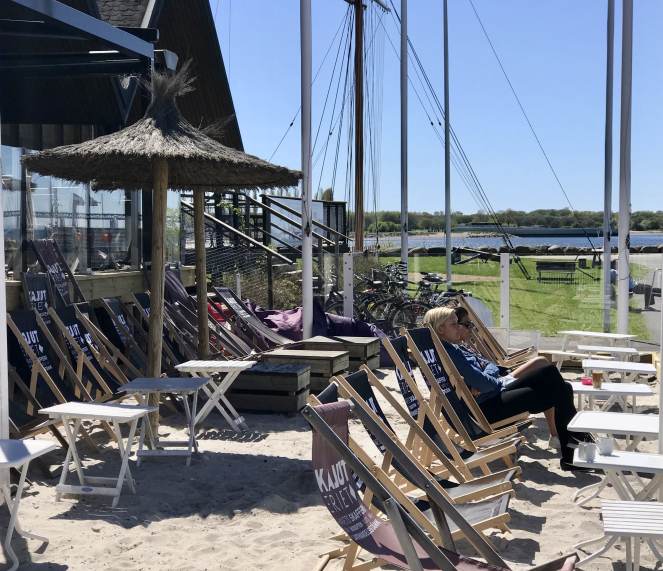
Deck outside Restaurang Kajutan. Limhamn, Sweden.

One of my favorite escapes when the sun comes out is to ride my bike down to the Limhamn harbor. This California girl needs her sun, sea and sand. Fortunately, there is a wonderful restaurant where I can go and feel slightly like I am at home, Restaurang Kajutan.

Restaurang Kajutan offers views of the Öresund Bridge, boats, and even has its own sandy beach lounge complete with beach chairs.

The restaurant has 2 bars – one to serve the outside beach area and another inside. They have a full bar and an impressive wine list.

The food is really good too. They have a menu that offers both seafood and meat. The lunch menu is a great value. The Caeser Salad with chicken is a really good size, and comes with a lot of chicken and a lot of bacon. Paired with a nice white wine and I am one happy camper.

So if you are looking for a place to enjoy some sun, sea air and unwind, head to Kajutan, grab a beach chair, order some lunch and a cocktail.

fullsizeoutput_b63c
Beach. Restaurang Kajutan. Limhamn, Sweden.

Kajutan can be found at Bryggövägen in Limhamn, Sweden.

For reservations, telephone: +46 040 155494 or info@kajuteriet.se

Americans abroad · Dalsland · European travel · ex-pat life · favorite recipes · food · Göteborg Sweden · Gothenburg Sweden · Malmö · Malmo Sweden · Skåne · Skåne Sweden

Kanelbullar – A Swedish Tradition

cb5
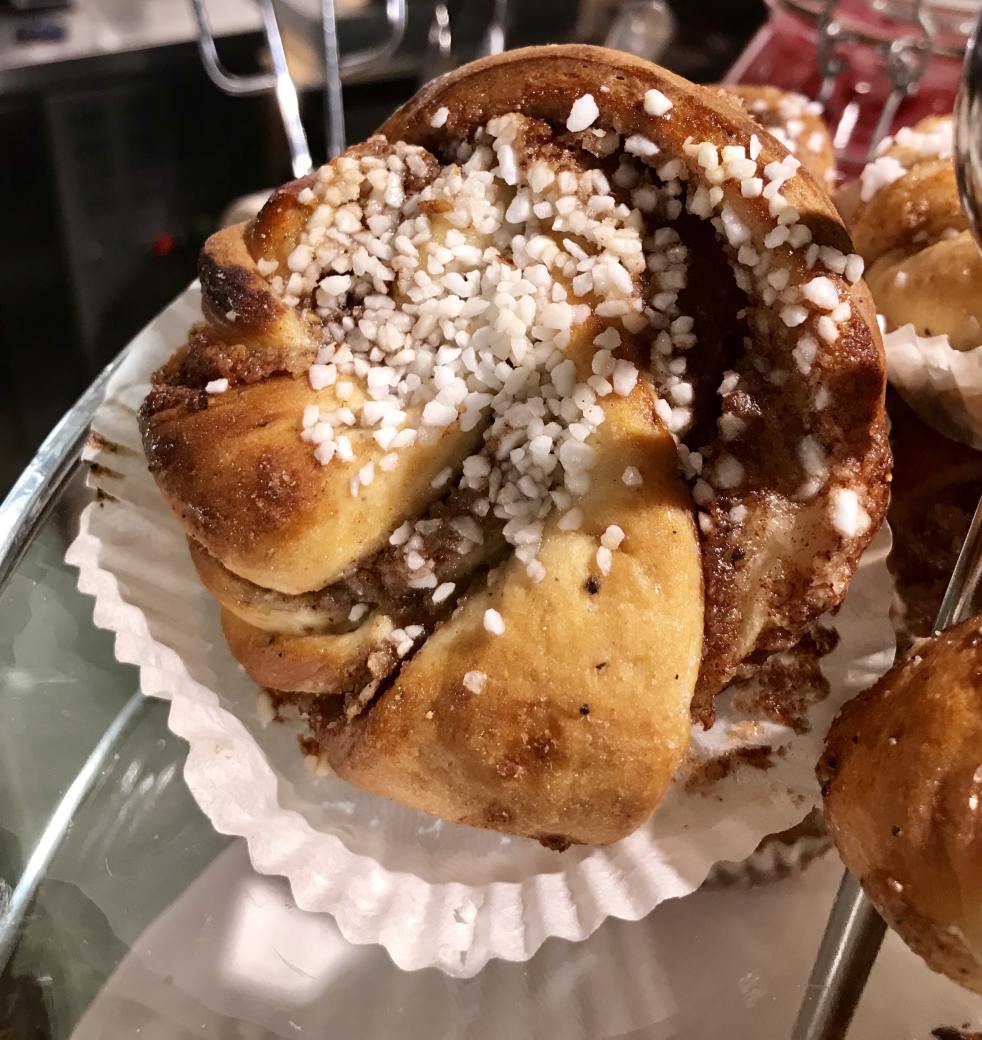
Kanelbullar | Niche Travel Design

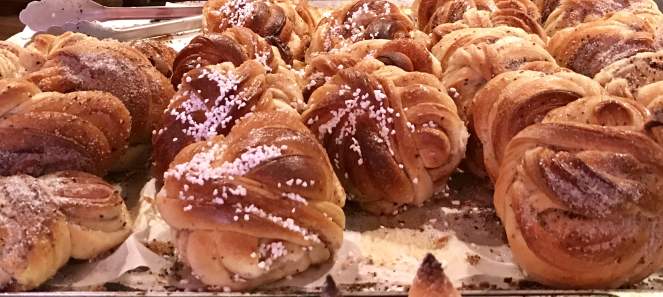
According to the Swedish Board of Agriculture and Statistics, Swedes eat a lot of cinnamon buns or kanelbullar as they are known here.

Apparently, the average Swedish person eats the equivalent of 316 cinnamon buns per year. That is almost one cinnamon bun per person, per day.  Kanelbullar are by far the most popular pastry treat in Swedish culture, so much so, that they have their own national day of celebration every October 4th.

When I moved to Sweden, I was given this recipe to make kanelbullar at home. The recipe has been passed around to the newbies at my international club.  Allegedly, it is an authentic hundred year old recipe.


Kanelbullar

Makes: 12 buns
Preparation: 45 minutes (+ 2 hours rising time)
Preheat the oven to 180°C (360°F, gas 4, fan 160°C)

Ingredients:

Dough
250 ml (1 cup) whole milk (3-4%)
100 g (3½ oz) unsalted butter (1 tbsp less than ½ cup)
1 egg
500 g (4 cups) strong white flour (bread flour)
½ tsp ground cardamom*
50 g (1/4 cup) caster (superfine) sugar
1 tsp salt
7 g (1/4 oz) fast action dried yeast (1 packet “instant” yeast)

*Cardamom is optional, but very popular in Sweden so if you want an authentic Swedish kanelbulle, the cardamom is important. Cardamom can be found at almost every grocery store in Sweden. If your supermarket does not carry it, search out an Indian foods market as cardamom is a common ingredient in many Indian recipes. If all else fails, you can order to order it online.

Filling
150 g (3/4 cup) light brown sugar

3 tbsp ground cinnamon
60 g (1/4) unsalted butter, very soft

Topping
1 egg, lightly beaten

3 tbsp pearl sugar.  Pearl sugar can also be found at many grocery stores in Swede. If you cannot find it in your neck of the woods. you can substitute regular or powdered sugar. Alternatively, try small flakes (slices) or almonds.

Directions:

  1. Place the milk and butter into a saucepan and heat on medium until the butter is melted. Remove from the heat and allow the mixture to cool to a lukewarm. Once lukewarm, mix in the egg.

  2. Place the flour, cardamom, sugar, salt and dried yeast into a large bowl and mix together.

  3. Add the liquid mixture to the dry ingredients. Mix and form a dough ball. Place the sticky dough on a floured surface and knead for 5-10 minutes or until the dough is smooth and elastic.

  4. Place the dough in a clean bowl and cover with a kitchen towel. Place the bowl somewhere warm and allow the dough to rise until it has doubled in size. Rising usually takes anywhere from an hour to an hour and a half.

  5. After the dough has doubled in size, place it on a lightly floured surface. Roll the dough flat into a rectangle. It should measure approximately 25 cm x 35 cm (10” x 14”).

  6. Mix the sugar, cinnamon and butter together to form a smooth paste for the filling. Spread the filling evenly across the dough.

  7. Roll the dough starting along the longer edge. Cut into twelve rounds. Place on baking trays lined with parchment paper and cover with a kitchen towel. Allow the rolls to rise again until they have almost doubled in size. It should take about 45-60 minutes.

  8. When ready to bake, brush the top of each bun with the beaten egg and sprinkle with pearl sugar. Bake for 20-25 minutes or until golden brown.

  9. Invite friends and family.

10. Serve warm or cold with a hot tea or cup of coffee.


Americans abroad · art · Beauty Essentials · European travel · ex-pat life · ex-pat reality · food · Insider Tips · international travel · Malmö · Malmo Sweden · restaurant · Skåne · Skåne Sweden · Travel

AbSmåland: Where The Unexpected Meets The Traditional

My New Favorite Cafe In Malmö

I went for coffee today with my daughter and discovered my new favorite cafe/store/space in Malmö, Sweden, AbSmåland.

Hard to describe, but oh so inviting, AbSmåland is a “lifestyle concept where the unexpected meets the traditional.” It is a gardening and plant store, a cafe, a furniture store, a home design store, a space for creating and a baby store. It takes up 1450 square meters. It is a big, luscious space. And it smells reeeaally good.

We started in the cafe. AbSmåland’s café is organic and fair trade. And, in my humble opinion, they have the best cardamom roll in Sweden. Unfortunately, as it was not gluten free, I could only have a nibble and appreciate it from afar.

My daughter and I both had pretty decent cappuccinos (after Italy it is hard to be impressed) but the nicest bit was free regular coffee refills. We were there long enough that the lunch crowd starting wandering in. The lunch smells began wafting out of the kitchen. Did I mention that it smells really good in there? The cafe serves soup, salad, and the famous Swedish smörgås (open faced sandwiches).

The Space

After coffee and buns, we wandered around the rest of the space. I read that the space wants to invite creativity and curiosity. As such, throughout the space, there have placed windows, plants and lots of color.  ​

This slideshow requires JavaScript.

They also offer bedding, clothing and baby items for the ever so modern and stylish Swedish babies.

The Workshop

As I was leaving I asked one of the employees what was upstairs. “Go explore and find out” was his response. Challenge accepted. I discovered that the upper floor houses a workshop that offers creative endeavors.

At the workshop one can create: your own textile to upholster the furniture that you purchased downstairs; your own seasonal bouquets with a professional florist as your teacher; macrame baskets; your own hanging garden. The workshop also facilitates sessions with local artists from time to time.

AbSmåland’s website says that their ambition “is to offer an inspiring venue with a creative atmosphere where everyone feels welcome.” I would say that they have succeeded. I, for one,  cannot wait to return.

​You can find AbSmåland at:
Södra Förstadsgatan 25/27
211 43 Malmö
072-248 89 20
hej@absmaland.com

Americans abroad · art · European travel · ex-pat life · Göteborg Sweden · Gothenburg Sweden · international travel · Malmö · Malmo Sweden · Skåne · Skåne Sweden · Travel

Stripes – The Swedish Summer Uniform

Let’s talk about stripes.

I’m not talking about the 1981 Bill Murray comedy or prison garb. I am talking about the recent spate of stripes in fashion. They have taken over Sweden. So much so that I felt compelled to blog about it.

I noticed immediately upon moving to Sweden that Swedish folks like stripes, but back then,  it was a cute little thing that I noticed. Today,  stripes have become the official Swedish summer uniform.  There are babies in stripes, mothers and daughters in matching stripes, old people, young people, purses, shoes, shorts, shirts, hoodies.

So. Many. Stripes. 

I noticed them in Poland, Germany and the Czech Republic to a small degree (now that my stripe antenna is up), but no where is it more prevalent that Sweden. You cannot walk 2 feet without seeing stripes.

So it left me wondering . . . is this just the latest fashion sweeping the world or is this a Swedish thing??

I asked some Swedish friends and a few shop keepers about it. None of them seemed to know why it is such a popular summer fashion theme here. One women suggested it is because Sweden is a country that has embraced water – the sea, lakes, and rivers. As such, stripes represent the nautical theme of the country. This was just her opinion though. She had no empirical evidence to offer me. I did a little research and found nothing related to Sweden, striped clothes and water.

Now, I know that striped clothing is everywhere. It is not unique to Sweden, but what is different here is the sheer number of people who seemingly overnight start wearing stripes.

How Many Stripes Are There?

Just to give you an idea of how many stripes there are in Sweden, the following pictures were taken while walking around Stockholm in a 30 minute period. 30 minutes!!  And I have about 60 more photos that I didn’t include.  I apologize for the quality – I was on the move.

In Sweden you will see royal blue and white combos:

The black and white :
The grey and white combination:

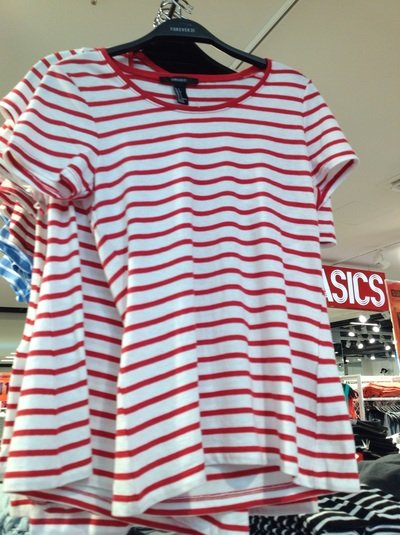
 And red and white,  red and other and just other:
The most popular choice, however, is the navy and white combination:

A little more digging and I discovered that the classic navy blue and white striped motif actually originated on the coast of Brittany in France. Many a French seaman was given a striped shirt bearing 21 horizontal stripes (one strip for each of Napoleon’s victories) as a uniform, known as a matelotor marinière.  It is reported that the stripes were functional and allowed sailors to see shipmates that had fallen overboard. How this fashion statement moved from Brittany around the world is a topic of much debate, but there is no doubt that stripes have earned a top place in the fashion world and are considered a staple of a classic wardrobe.

But back to my premise that stripes go beyond a fashion statement here in Sweden and have morphed into a uniform.  I ask you my friends – is this a Swedish thing? Have you noticed a prevalence of stripes in your neck of the woods?? Or is there another common clothing item that you have noticed where you live?  Tell me in the comments what you have noticed.

Americans abroad · European travel · ex-pat life · Göteborg Sweden · Gothenburg Sweden · international travel · Malmo Sweden · nature · Skåne · Skåne Sweden · Travel · travel

Bonfires, Bulbs and Bursts of Color – Swedish Spring

As many of you know or have read, Scandinavian winters can be long, dark and cold. Here in Sweden, springtime marks the important renewal of light and hope springs eternal. One thing I love is that it feels as if one day you have gone to sleep and the next you awake to a dramatic burst of color as the bulbs begin to flower all over Sweden. It is quite spectacular really.

To mark the momentous occasion when light returns to one’s life,  the beginning of spring in Sweden starts on April 30th on  Walpurgis Eve or Valborgsmässoafton in Swedish. The official holiday is May 1st, but the celebration begins the night before.

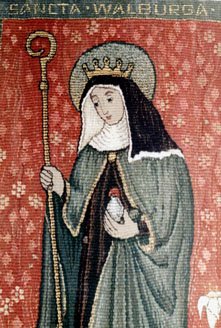
Walpurgis (also spelled Walburgis) is celebrated in many countries in Europe, and Sweden is no exception. Valborg (Swedish spelling) has been celebrated in every village and city throughout Sweden since the Middle Ages. Valborg ushers in spring and honors the life and sainthood of an 8th-century nun, St. Walpurga.

st-walpurgis-2-sized
Like many Christian celebrations, Valborg has both pagan and Christian roots.  In the days before Christianity took hold,  farmers were willing to do just about anything to insure a good crop. After all, a failing crop was the difference between life and death. At the beginning of spring each year, farmers attempted to ward off evil, ensure fertility and cleanse the land of winter. Farmers prepared the soil and nurtured it by burning all the dead dry wood, brush and grass to invite new fertile soil to emerge.

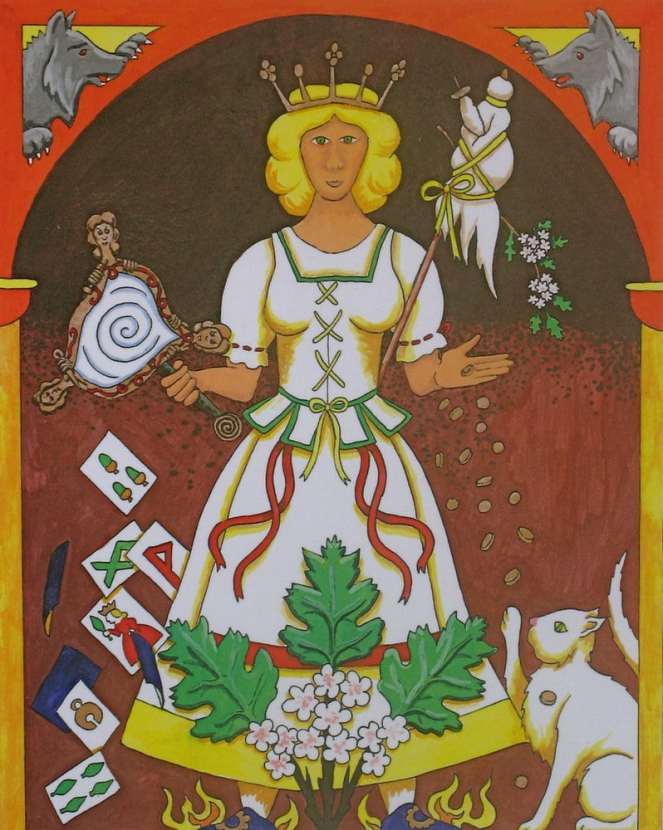
Then along came Walpurga.  As with most stories from ancient lore, St. Walpurga’s story is varied depending on who is telling it. From what I could gather,  Walpurga was a nun who is said to have performed 2 miracles during her life, saving a child from starving with 3 sheaves of wheat and calming a rabid dog.  A third miracle, which resulted in her canonization, is said to have occurred after her death.

The story goes that on the day that Walpurga was buried, the rocks making up her tomb started oozing a healing oil.  The oil was seeping from the relics that were buried with her.  The healing oil provided miraculous cures for ill people and became so significant that Walpurga’s body was reportedly removed from the tomb, dismembered and distributed around Europe to help spread the miracle.  I could not find a clear explanation as to why the church would dismember her when the oil was coming from her relics, but I digress . . .

As a result of the healing oils coming from her tomb, Walpurga was canonized on May 1, 870, and became eternally tied to the pagan springtime rituals on April 30th. Today she is considered to be the saint that protects against storms, diseases and plagues, rabies, famine and failed harvests – she is essentially the patron saint of springtime.

walpurga_by_thorskegga-d4z8rl1
Photo credit: Thorskegga

My experience of  Valborg today, is that it feels akin to what we call a block party in the USA.  I have been told that bigger cities celebrations are more like a carnival, and the student cities are like an all out, city wide, drunken party, but the celebrations that I have attended are sweet gathering of family, neighbors, and friends.  People picnic, drink, sing songs. The kids play and then the main event, the bonfire is lit.
IMG_0304

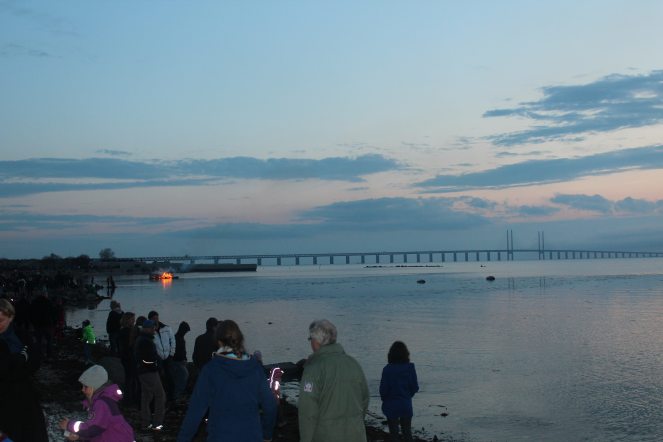
The bonfire may be small, medium or large in size. Some are burned on land, others out on the a barge on the water.  No matter where it is or the size of the fire, the bonfire is the star of the event.  Growing up in California where the grass is often quite dry and prone to brush and forest fires, I had never seen a bonfire up close. They are hot, and powerful, and oddly, a bit enchanting.

IMG_5622.jpg
A bonfire burning out on the water.

What really struck me though as an American, and a lawyer by trade, was the active participation of children of all ages in the lighting and tending of the bonfire.  Children assisted with the initial lighting and then continued to search for things to throw on the blaze. It was like a treasure hunt for flammable items. Not only were they participating, they were playing near and around the fire as it burned. Not a helicopter parent in sight. In the USA not only would each city erect barriers to keep everyone except the expert at bay (and let’s face it, to avoid any liability) but, the majority of parents would not allow their children to lend a hand or play near the fire.

I took comfort though knowing that this celebration and children’s participation in it, have been going on for longer then the USA has been a country. The Swedes seem to know what they are doing. And boy did the kids have fun.

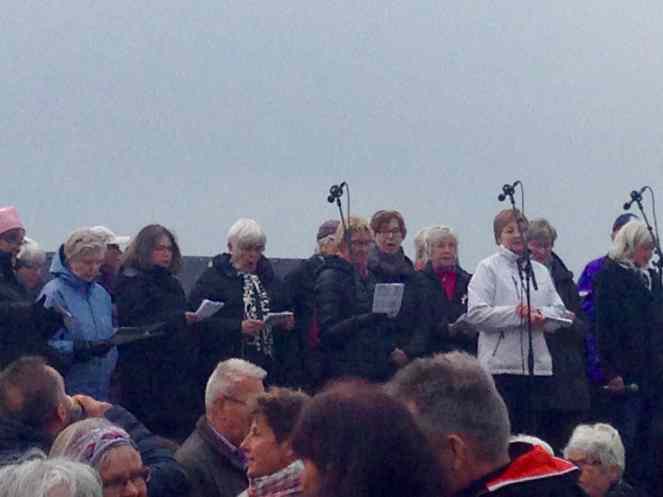
After the fire had burned down, a group of older Swedes began singing odes to spring  – songs inviting spring to please hurry and to bring sun, flowers, hiking. Songs about the joy of being outside after a long dark winter.
IMG_0310
I could not understand many of the words of the folksongs, but it didn’t matter.  The singing lent a nostalgic feel to the event, particularly because it seemed to be an older person’s gig.  It was as if there is a societal code at work. The young people burn away the old and prepare for the newness of the world, while the elders remind everyone that people have been welcoming spring in this way for centuries. It was a perfect ending to a lovely evening.

Americans abroad · art · Copenhagen Denmark · Denmark · European travel · ex-pat life · international travel · Malmo Sweden · Modern Art · Travel

Sun, Sea & Picasso – The First Day of Spring at The Louisiana Museum of Modern Art

We here in Scandinavia have had an unusually long winter – 5 1/2 months to be precise. 5 1/2 months of snow, sleet, rain, cold grey days.  This weekend the spell was broken, however. It was sunny at last. A proper spring day with sun and a chill in the air. All day I kept hearing the Beatles refrain in my head , “Here comes the sun . . .”

In honor of the lovely first day of spring we headed to one of our favorite indoor/outdoor spaces – The Lousiania Museum of Modern Art in Humlebæk, Denmark.

The museum sits on a bluff overlooking the Öresund Strait and enjoys sweeping lawns with an incredible display of sculpture, trees, flowers, sea breezes. Just visiting the grounds are worth it, but then there is the museum itself. Architecturally, the museum structure and grounds evoke Frank Lloyd Wright and his philosophy of bringing nature into the building. The museum is designed with lots of big windows whose function it is to bring nature inside the museum walls. It is a space that simply makes one feel calm, peaceful and good.


The grounds have sculptures scattered throughout. The sculptures are not placed haphazardly, however. The sculptures are specifically positioned in order to interact with the architecture and nature that surround them. The placements are precise and are designed to allow visitors to enjoy a different experience with each visit depending on the weather and the season.

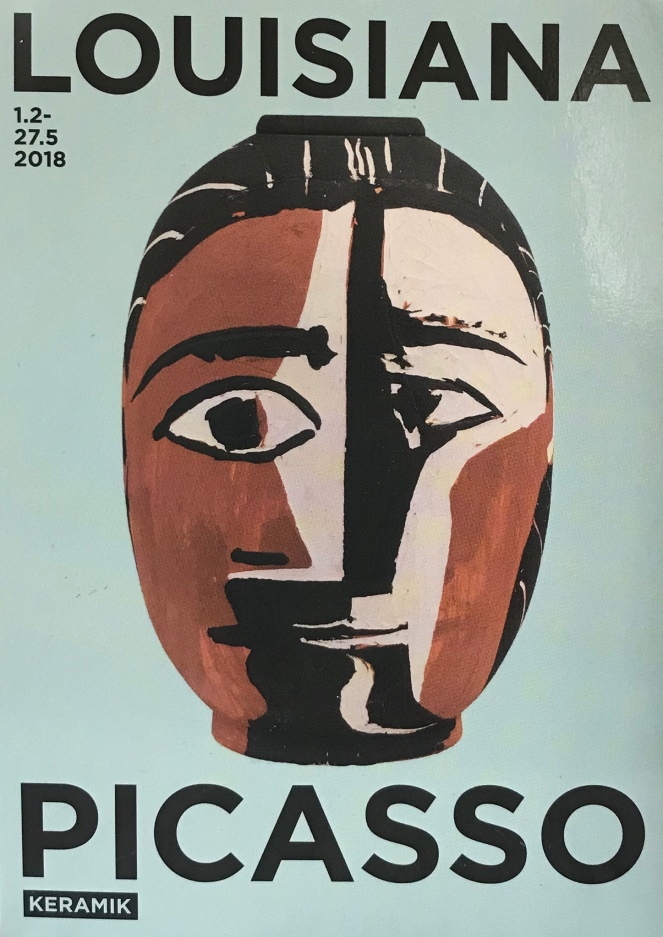
We would have been happy just enjoying the sun and sea that day, but imagine our surprise when we arrived and discovered that there was a Picasso ceramics exhibit going on. This particular exhibit was named one of the top exhibits to see in 2018 by the New York Times and it does not disappoint.

fullsizeoutput_b40b.jpeg

In fact, it was stunning. One of the things I have always loved about Picasso is that his work is so dynamic and prolific –  his work encompasses traditional paintings, the cubists phase, sculpture and then his colorful, whimsical ceramics.  There are over 160 pieces on display and a lovely film offered with English subtitles about this particular creative period in Picasso’s life.

Picasso’s interest in ceramics began in the summer of 1946 when he attended an exhibition in Vallauris, France, an area known for making ceramics since Roman times. After WWII, and at at the height of his success, Picasso returned to Vallauris seeking new artistic experiences. The war had worn him down emotionally and he sought new challenges and inspiration artistically.  In this last period of his life he began to pick up clay and he immediately began experimenting with the materials, glazing techniques and processes. Apparently, Pcasso loved how unpredictable the firing process was on the clay and he enjoyed the resulting surprise of colors that emerged.

All in all, it is estimated that Picasso produced over 4,000 cera­mic objects during this time. It is said that one of the things that inspired him to create ceramics was the desire to put art in the hands and lives of the common man.  By turning utility objects like a platter or a water pitcher into an art piece, it allowed art to enter the every day world. So dedicated to the concept of making art available to all, Picasso created a line of work called Edition Picasso which were created specifically to be affordable. Picasso essentially served as the designer and allowed a ceramic workshop in Madoura, France to actually replicate each piece. This was one of the first (if not the first) times in art history that copies were mass produced based on an original work.  Picasso’s confidants advised him against this idea warning him that the practice would devalue his other works. Picasso soldiered on with the idea and from 1947 – 1971 he designed over 600 editions for the collection. And while initially affordable, once the artist died, the Edition Picasso ceramics went steadily up in price and did no damage at all to the value of Picasso’s other works.


If you are in the Copenhagen area and are looking for a unique museum experience as well as an outstanding collection of art, I highly recommend the Louisiana Museum of Modern Art. And if you are not in the area just now, keep a look out for the Picasso ceramic exhibit coming to a museum near you. You will not be disappointed.