Adventure travel · Americans abroad · aperitivo · art · Beauty Essentials · Bologna Italy · Bosnia Herzegovina · celebrity travel tips · Christmas cocktails · cocktails · Color Street · concierge · Copenhagen Denmark · Croatia · Dalsland · Denmark · Emilia Romagna · Emilia Romagna · European Christmas Markets · European travel · ex-pat life · ex-pat reality · favorite recipes · fika · Firenze Italia · Florence Italy · food · France · Göteborg Sweden · Germany · Giethoorn · Gothenburg Sweden · Hamburg · Helsingborg · Holland · Honeymoon travel · Insider Tips · international travel · Italian cocktails · Italian food · Italian recipes · Italy · Krka · laundry · Liebster Award · luxury travel · Maastricht · Malmö · Malmo Sweden · Modern Art · Mostar · mysig · national parks · nature · Off The Beaten Path · Paris · Parma Italy · parmigiano-reggiano · pastel de nata · Plitvice Lakes · Poland · Portugal · Prosciutto di Parma · restaurants · Saturnia · Skåne · Skåne Sweden · spa · Spain · The Netherlands · The Private Suite · The Unique and Unusual · Thermal baths · Tourettes-Sur-Loup · Travel · travel safety · Tuscany · UNESCO World Heritage Site · USA · Wadden Sea

The Liebster Award!

Niche Travel Design has been nominated for The Liebster Award!

I was nominated by A World in Reach for this peer award. For a somewhat new blogger like me, this is a special treat.  It’s always a great feeling to be recognized by your peers. Thank you, Sydney and A World in Reach.

What is the Liebster Award?

The Liebster Award is a peer to peer award, given to bloggers, by bloggers as a way to foster collaboration and support. What a nice idea.

I noticed a message board in my German friend’s house that said “liebe und respekt.”  I asked what liebe or liebster meant.  She told me it means dearest or kindest. Thus, bloggers being dear and kind to one another. This is an award I can get behind. I am always seeking advice from others and I am happy to promote the idea of collaboration. I strongly believe in the theory that what you give comes back to you.  

The Rules of Engagement

Once you’re nominated with the Liebster Award, you have to follow a few rules to celebrate your win and spread the award throughout the blogging community.

1. Thank the person who nominated you, and put a link to their blog on your blog.

2. Display the award on your blog.

3. Write a small post about what makes you passionate about blog posting.

4. Provide 10 random facts about yourself.

5. Answer the questions from your nominator and provide a fresh set of questions for those you nominate.

6. Nominate 5 – 10 blogs that you feel would enjoy blogging about this award.

7. List these rules in your post.

How I Began My Blogging Journey

I began blogging when I first moved from California to Parma, Italy in 2011.

When my daughter was a toddler she frequently made up words that sounded similar to the adult versions. She would say strawbellies instead of strawberries; froggy instead of foggy. One of the words she transposed was Parmesan. In her toddler mind, Parmesan cheese was Purple John cheese. For years our family asked each other to pass the Purple John cheese at the dinner table.

Imagine our surprise when we realized that we were moving to Parma, Italy – the birthplace of Purple John cheese.  Apparently, the universe has a sense of humor. It seemed like serendipity. What we did not know is that an international move is difficult. Life in another country is difficult. It is not all adventure.  I had 2 very sad children who did not want to move and leave the comfort of their home.

[dropshadowbox align=”none” effect=”lifted-both” width=”auto” height=”” background_color=”#ffffff” border_width=”1″ border_color=”#dddddd” ]Read about the reality of an international move here.[/dropshadowbox]

All that being said, life in Italy was often quite funny because things were soooo different than what we were used to. Thus, my original blog, Purple John, began by me just telling friends about the difficulties and the funny stories that we encountered along the way.

[dropshadowbox align=”none” effect=”lifted-both” width=”auto” height=”” background_color=”#ffffff” border_width=”1″ border_color=”#dddddd” ]Read funny stories about life in Italy in the drop-down menu here. [/dropshadowbox]

And of course, just when we were settled into life in Italy, the universe struck again and we had a second move to Malmö, Sweden. Once we moved and settled into Malmö, I toyed with the idea of reworking my past experience as a travel consultant and incorporating the blog as part of the business. The kids were older and they did not need me as much as they did in Italy. This last year I began my existing blog Niche Travel Design using my name and domain name from the travel business that I ran in the USA. So now my travel business has a blog attached to it.

My blog still occasionally includes funny ex-pat tales of excitement and woe, but now I am more focused on the business of travel. The funny thing, though . . . that little toddler that inspired my first blog name, she now works with me on the business.

At Niche Travel Design, our philosophy is that designing the perfect vacation is as much an art form as designing a home’s interior or a garden’s landscape. We curate a unique experience for each of our clients. 

We are experts in finding the best cup of coffee, the most interesting art gallery, the best place to sip Prosecco while watching the sunset, and the best accessories to make your adventure more comfortable.

Niche Travel Design is more than a travel blog. We are a community featuring stories of life abroad, cultural experiences, recipes, ideas, and tips for creating unique memories to last a lifetime. We also recommend products and services.

10 Random Things About Me

  1. I once sort of crashed a funeral. My friend was supposed to go and I was staying with her so I went too because it was celebrity filled. In the end, I felt like a heel and a looky-loo. People (even celebrities) were grieving. I don’t recommend it. Not my best moment.
  2. I always top off my gasoline, despite the warnings.
  3. I love Gene Kelly movies and I got to meet him once and had a conversation with him about his more obscure movies. It was amazing and he was so kind.
  4. I am secretly a Carpenters fan. I guess it is not a secret anymore. 
  5. I sing all the time in public even though I really shouldn’t.
  6. I once got into a car accident on the way home from a car accident and neither one was my fault. I know you don’t believe me, but it is true.
  7. Apparently, according to my family, I say Google incorrectly? Who knew?
  8. I hate, I mean really hate, The Pillsbury Doughboy. His voice makes my skin crawl.
  9. I once stayed at a “pensione” in Barcelona that was actually the host’s children’s room. He was clearing toys out of their bedroom. It was weird, but it was late and there was a train strike so I paid to sleep in a stranger’s kid’s bed.
  10. I generally don’t like chick flicks despite being a chick. I seem to be missing a gene or something.

A World In Reach’s Questions For Me

What is the most important lesson you’ve learned during your travels? That once one strips away all the cultural differences, we are all the same. We all just want safety, family, friends, love, and respect in our lives.

What’s your favorite part of traveling? Exploring and learning about a place. Finding off the beaten path things to do. I am a researcher and enjoy the discovery of new things to do, a great local restaurant, a specialty shop, an unusual experience in a typical tourist spot. Least favorite? The getting there bit. The airports, etc.  Ugh.

Do you collect any souvenirs from your travels? I used to collect art from each place but now I have too much. I had to stop. No more room to hang anything. We have also always collected ornaments for our Christmas tree. It is nice to remember our trips as we put up each ornament every year. Now I collect photographs and memories.

What is the most unique experience you’ve had with a local while traveling? Swimming with horses in Croatia. Just incredible.

[dropshadowbox align=”none” effect=”lifted-both” width=”auto” height=”” background_color=”#ffffff” border_width=”1″ border_color=”#dddddd” ]Read more about swimming with horses here. [/dropshadowbox]

If you could travel with one person you’ve never traveled with before, who would it be? Barack Obama. He is intelligent, funny, has done some cool stuff and met a bunch of interesting people. I’ll bet he has good stories. Plus, he gets V.I.P. treatment and if we were traveling together I’d get V.I.P. treatment too.  

How did you come up with your blog name? It was the name of my travel business in the USA. I focus on niche, unique, unusual travel experiences. I curate and design your trip for you.

What tip would you give to a new blogger? Learn all the technical stuff before you begin.

Is there a book or a movie that has inspired your wanderlust?  No. My wanderlust was developed as a child. Actually, I feel like it has always been there. 

What are the top 3 things on your bucket list? Africa – all of it!  Australia/New Zealand and Asia.

What is your biggest travel regret? I had a chance to go to Africa for a summer. I didn’t go because it wasn’t practical. I should have gone.

My Nominations for The Liebster Award

I have really enjoyed the Liebster Award process. I also enjoyed reading about each of these bloggers that I am nominating. I hope that you each take the time to read up on what they have to offer.

1. Divine Kabwe at beingyourselfblog.wordpress.com 

2. Diana Danciu at ourblindlife.com

3. Jenny Toney Bhatia of travelingpartyof4.com

4. Temeka Flack Green of worklifemommyhood.com

5. Heather Eyre of thefemalefactor.me

6. Jamie Joseph of wearefreeindeed.wordpress.com

7. Samantha Norman of SammiNormanFit.com

8. Louise Emerson of 12books.co.uk

9. Mallory Herrera of mamaonparade.com

10. Megan Henderson of thehendersonhouse.org

Questions For My Nominees

Since I have a travel blog, my questions are all about travel.

  1. Where would you go if money and time were not issues?
  2. What is the best advice you would give to new travelers?
  3. What is the one accessory that you cannot travel without – your phone and/or computer don’t count?
  4. Where is one place you would return over and over again? And why?
  5. Where is one place you’ve been but never want to return to? And why?
  6. What is the funniest travel mishap you’ve had?
  7. What is the scariest travel experience you’ve had?
  8. What is your favorite travel souvenir?
  9. What is your favorite local cuisine?
  10. What is your next destination?

Looking forward to reading my nominees’ answers and getting to know them better.

And once again, a BIG THANK YOU to A World In Reach for my nomination!

Everyone, please be sure to check out Sydney’s blog for ideas on budget travel. A World In Reach can provide you with all sorts of ideas on traveling on a budget.


Americans abroad · aperitivo · European travel · ex-pat life · international travel · Italian food · Italy · parmigiano-reggiano · Prosciutto di Parma · Travel

The Classic Italian Summer Cocktail – The Aperol Spritz

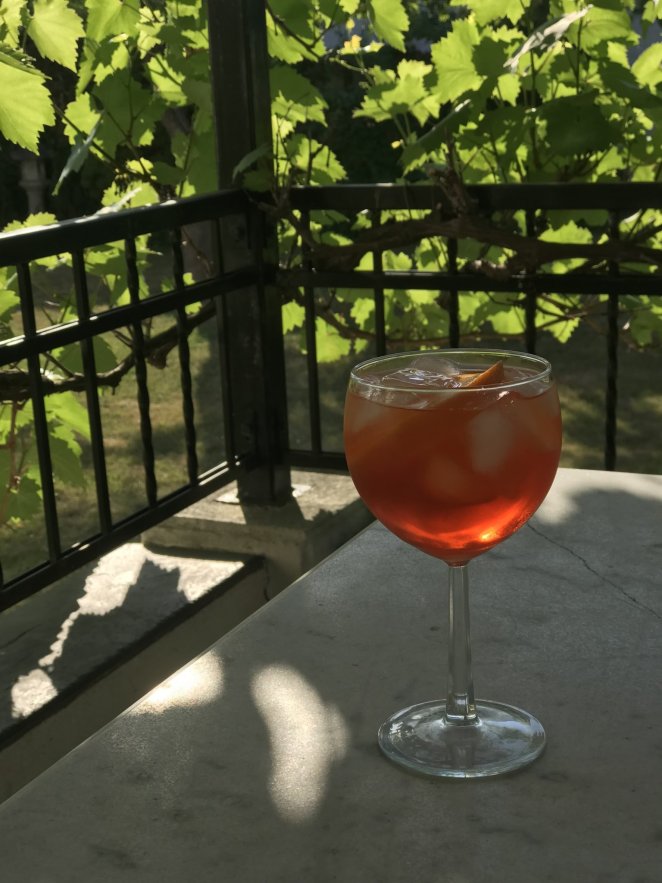
Orange drink in wineglass.

Italian summers are hot. And humid. Some days it feels as if you are melting. So one needs a refreshing drink to get by. And that is where the classic Italian summer cocktail – the Aperol Spritz comes in.

Aperol is an Italian apéritif (aperitvo in Italian) made of bitter orange, gentian, rhubarb, and cinchona among other ingredients. Ok, seriously does anyone know what gentian or cinchona are? I didn’t. So I looked them up. Gentian is a cute little purple flower. Technically it is an herb from the alps, that is commonly used as a digestive aid.  Cinchona, also known as quina, is also a medicinal plant from South America. How it found its way into an Italian drink I have no idea.

Aperol was originally produced by the Barbieri company, based in Padua, but is now produced by the Campari company. While Aperol was originally created in 1919, it did not become successful until after World War II.

campari
Photo credit: Campari.com

It is funny to me that the Campari company bought Aperol since the two drinks taste so  similar to me.  I guess they wanted to eliminate the competition. While they are similar in taste, Aperol has half the alcohol content of Campari.

Speaking of taste, Aperol tastes both bitter and citrusy at the same time. And orange is both the predominant color and flavor.

The classic Aperol Spritz cocktail is a combination of Aperol and Prosecco. Truth be told, I took a long time to warm up to The Spritz. I do no like anything to sully my Prosecco and the bitterness of the Aperol was an acquired taste for me. Now that I have acquired the taste however, I really enjoy it on a hot summer day.

While popular in Italy, the Spritz was not an international drink until the last 6 years or so when hipsters started drinking them in New York, London and San Francisco.
IMG_3121

If you fancy yourself a hipster or just like a refreshing drink on hot summer days, here are two recipes to try:

Classic Aperol Spritz

Fill wine glass with about three ice cubes
Fill glass 2/3 with Prosecco
Add 1/3 Aperol
Add a slice of orange

Modern Aperol Spritz

Fill wine glsss with about three ice cubes
Fill glass 2/3 with Prosecco
Add 1/3 Aperol
Add a slice of orange
Add a shot of gin
Add a splash of soda water

Pair with some Prosciutto di Parma, Parmigiano-Reggiano cheese, mostardo and olives and you have a fine aperitvo on hand. Or you could try your hand at this recipe.

Buon appetito a tutti!

Americans abroad · Emilia Romagna · Italian food · Italy · Parma Italy · parmigiano-reggiano · Prosciutto di Parma

Torta Fritta

Torta Fritta
Torta Fritta

One day, not long ago, I was craving this yummy little treat from the Emilia Romagna region of Italy. Torta Fritta as it is known in Parma or Gnocco Fritto if you are in the next town over because in Italy food is very regional and even if it is the exact same dish but it is in the next town it must have a different name.  Oh Italy, I do miss you.

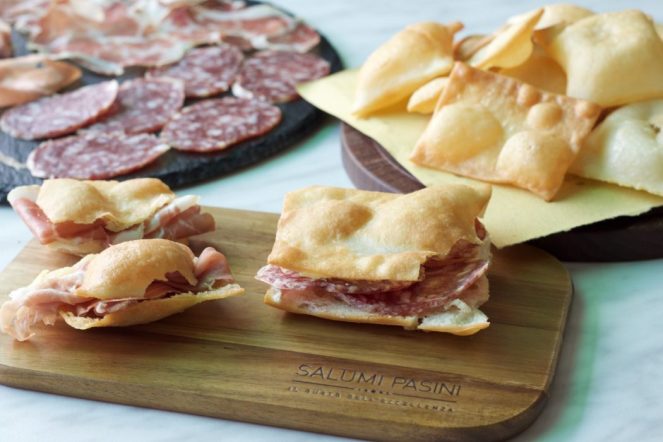
Anyway, there I was in Sweden dreaming of Torta Fritta. Torta Fritta are little pillows of dough, lightly fried and puffed up. They are most often served warm and stuffed with Parmesan cheese, Prosciutto di Parma, salami and various meats. They are little pillows of culinary heaven.

The thought never entered my mind to make them from scratch, because, you know, I am not Italian and Italian cuisine (real Italian cuisine not the over worked American versions) is intimidating. So I foolishly tried to Macgyver it and I bought some pre-made, albeit fresh, pasta with the intention of flash frying it into pillows. It didn’t work. It wasn’t pretty. And it certainly wasn’t Torta Fritta.

What I forgot is that while living in Italy I discovered that most Italian recipes are actually quite simple. They pair a few ingredients that happen to compliment each other. They don’t over work, they don’t add too much. They let the flavors meld and do all the work. Then I remembered that one of my favorite gifts that I received when moving from Parma was a cookbook given to me by my gem of a friend, the amazing Beatrice Zambelloni Papoccia. Bea is the Martha Stewart of Italy and one of the best cooks I have ever had the pleasure of tasting. She gave me a book titled Ten True Gems of Parmesan Cuisine. I cautiously opened it, searched for the recipe and said a little prayer to Don Alfonso.

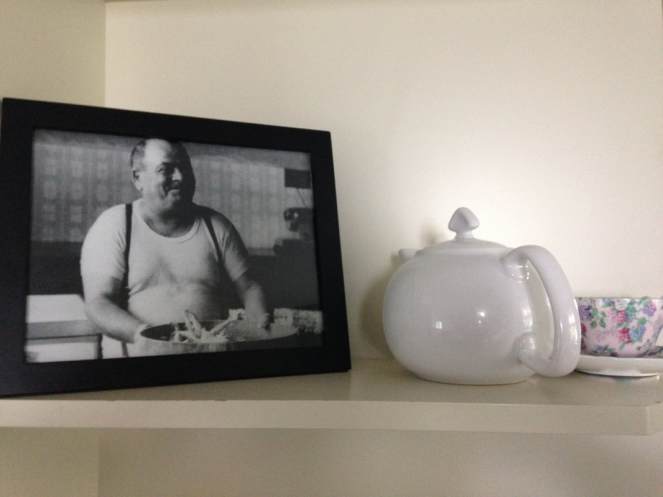
Sidebar – Don Alfonso was the original proprietor of our favorite restaurant in Parma and the staff was kind enough to give me a commemorative photo of Don Alfonso when we moved. He sits on a shelf in my kitchen overseeing it all, and I like to believe, spreading good Italian food mojo around the kitchen.

torta fritta
The Don, overseeing it all.

I opened the cookbook and there it was. The recipe.

And here it is for you now:

​Torta Fritta – enough for 6

1/2 a kilo of white flour
water
salt

Mix the ingredients, adding enough water to obtain a rather soft dough. Roll out the dough to a thickness of 1/2 a centimeter. Cut it into rhomboids with a pasta cutter. Fry the pieces in oil or lard. Torta Fritta can be served hot with cheese and meat and if there happens to be any leftover, ​it is excellent eaten cold the next day, dipped into milky coffee or with jam.

I know what you are thinking. I know that you are judging me because it is soooo easy, but let me tell you when you have tasted fresh Torta Fritta that has been handmade by your neighbor’s nonna it tastes complicated. I also know that you want to know the precise measurements of the water and salt but this recipe has been handed down for hundreds of years and you will just have to work it out.

Finally, just because I am American, if you want to complicate the recipe, I read that sometimes, a drop of milk is added to soften the dough.

Buon appetito tutti!

Americans abroad · Bologna Italy · Emilia Romagna · ex-pat life · Italian food · Italy · Parma Italy · parmigiano-reggiano · Prosciutto di Parma

Prosciutto With Black Truffles and Truffle Mustard Dressing

This appetizer is so simple and so full of flavor you may end up serving it at every party you have from here on out!

The Recipe

Ingredients
4 tbsp extra-virgin olive oil
3 tbsp apple cider vinegar
1 tsp truffle mustard or dijon mustard
6 thin slices fresh black truffle, finely chopped
Salt and pepper
8 small slices ciabatta
1 tbsp extra-virgin olive oil (for brushing)
4 slices prosciutto
Small salad leaves, your choice
8 thin slices of fresh black truffle

Method
Make dressing first by mixing 4 tbsp olive oil, cider vinegar, mustard and finely chopped truffl e. Season with salt and mix well. Preheat oven to 160C. Brush ciabatta bread pieces with 1 tbsp of olive oil and toast lightly in oven for 8-10 minutes.

Meanwhile, cut each prosciutto slice in half to obtain eight pieces. Once toasted, remove ciabatta pieces and, while still hot, place a piece of prosciutto on each and nestle on serving plate with small salad leaves. Drizzle with truffle dressing and finish with a truffle slice on each crostini. Add a couple of turns of pepper over the lot and serve.

Thank you to http://www.goodfood.au for the recipe.

Americans abroad · Bologna Italy · Emilia Romagna · European travel · ex-pat life · Gelato · international travel · Italian food · Italy · Parma Italy · parmigiano-reggiano · Prosciutto di Parma · Travel

A Theme Park for Foodies? Italians Say Bologna.

Eataly
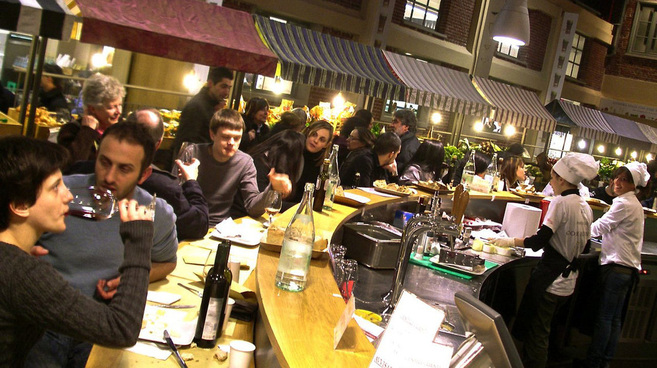
Customers dine at the original Eataly in Torino which opened in 2007.


By Sylvia Poggioli.

Italy has more UNESCO world heritage sites than any other country in the world, and its art and cultural riches have drawn visitors for centuries.

It also prides itself on being a culinary mecca, where preparing, cooking and serving meals is a fine, even sacred, art. And now that the country is in the deepest and most protracted recession since World War II, why not cash in on its reputation as a paradise for visiting gourmets and gourmands?

In late February, Oscar Farinetti, who founded the Eataly chain of food emporiums, announced a new plan to help rescue economy: “Fico Eataly World,” a theme park devoted entirely to food and wine.

The project is a joint venture between Eataly and the municipality of Bologna, which is providing 86,000 square feet of land with warehouses to be transformed into food labs, grocery stores and, of course, restaurants. The price tag for the park is estimated at $55 million.

Eataly, which has over two dozen branches around the world, was founded in Turin in 2007 by Farinetti, who is CEO and owns a 60 percent share. The other 40 percent is owned by cooperatives of the COOP group of supermarkets.

The cooperatives have their roots in the Communist Party that was powerful in the Emilia-Romagna region that surrounds Bologna in the post-war period. The founder of the Slow Food Movement, Carlo Petrini, is also left-leaning, and another example of the ties between the left and the contemporary gastronomy movement.

The location for the Eataly theme park could not be more appropriate. Italy has many very different cuisines, but Bologna and Emilia-Romagna are widely, if grudgingly, recognized as the gastronomic capital of Italy.

The region is the home of Parmesan cheese, prosciutto di Parma, balsamic vinegar, and lasagna, among many other delicacies. Since the Middle Ages, the city was known as Bologna La Grassa, Bologna the fat – as in, affluent and epicurean.

Today, Bologna is also home to the world’s only University of Gelato, as I in 2013.

The foreign media has referred to the planned food theme park as a “Disneyland of Food.”

But when I mentioned the “Disneyland for foodies” to people shopping at two well-known Roman outdoor markets, everyone grimaced in disgust.

“Sounds like something for tourists,” Simona Vitali, a middle-aged woman shopping for groceries in Piazza San Cosimato, told me. “We Italians have no need for such a theme park.”

Farinetti the online English language service ANSA he hopes the park will draw annually 10 million visitors who will “play with this magical thing, Italian food.”

Eataly World is scheduled to open Nov. 1, 2015.

http://www.npr.org/blogs/thesalt/2014/03/09/286939246/a-theme-park-for-foodies-italians-say-bologna

Americans abroad · Bologna Italy · Emilia Romagna · European travel · ex-pat life · international travel · Italian food · Italy · Parma Italy · parmigiano-reggiano · Prosciutto di Parma · Travel

Botticellis and Berlusconis

This slideshow requires JavaScript.

“First of all, let’s get one thing straight. Your Italy and our Italia are not the same thing. Italy is a soft drug peddled in predictable packages, such as hills in the sunset, olive groves, lemon trees, white wine, and raven-haired girls. Italia, on the other hand, is a maze. It’s alluring, but complicated. It’s the kind of place that can have you fuming and then purring in the space of a hundred meters, or in the course of ten minutes. Italy is the only workshop in the world that can turn out both Botticellis and Berlusconis.”
Americans abroad · Emilia Romagna · European travel · ex-pat life · international travel · Italian food · Italy · Parma Italy · parmigiano-reggiano · Prosciutto di Parma · Travel

St. Augustine

sta

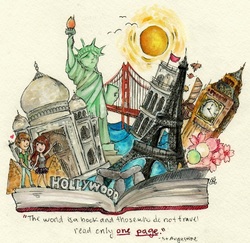
“The world is a book,
and those who do not travel
read only one page.”

~ St. Augustine ~

Americans abroad · Emilia Romagna · ex-pat life · international travel · Italian food · Italy · Parma Italy · parmigiano-reggiano · Prosciutto di Parma · Travel

Prosciutto di Parma

pdp2

Prosciutto translates from Italian into English as “ham.”  This is not an accurate and complete translation, however, as Prosciutto di Parma indicates a dry-cured pork that is unique to Parma, Italy.  To call it ham does not do it justice. This is not the ham one sees in the supermarket that comes in a gelatinous covering. Prosciutto di Parma is the result of culinary artistry and strict guidelines.

pdp1By law ham bearing the name Prosciutto di Parma may only be produced and cured in and around the countryside near Parma, Italy.  And, only Italian pigs are allowed. Each step in the production, from the breeding of the pigs to the final packaging is controlled by the Istituto Parma Qualità (I.P.Q.). Only the I.P.Q. has the authority to brand the finished ham with the seal of Parma’s five-pointed crown, indicating that the meat has cleared the rigorous standards required in production.
Prosciutto di Parma has been awarded the Protected Designation of Origin by the European Community designating it as a high-quality European food made according to traditional methods in a defined geographic region.

Prosciutto di Parma is all natural and as such, it is one of the first adult foods that babies are given to eat in Italy. There are no additives or nitrates.  Even water is restricted from the process.  The only ingredients are pigs, salt, air and time. And only the hindquarters are used in the curing process. No shoulder meat. No pork bellies.

Producing Prosciutto di Parma is not for the impatient and can take up to 3 years. The process is documented and traceable from the birth of the pig to the market.

The first step requires Italian pig breeders to place a mark on both rear legs of a young pig within 30 days of it’s birth. The mark indicates the pig’s place of birth, month of birth and a breeder’s code. This is to insure that only Italian pigs are utilized.

After slaughter, each leg is marked with a code identifying the slaughter house and a metal seal, attached to each ham during the salting stage, bears the Consorzio’s acronym (CPP) and the date at which processing began.

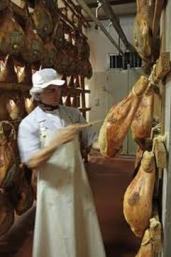
pdp3To begin the curing process, the legs are salted by a professional salt master or “maestro salatore.”  The “first salt” uses two types of salt depending on the portion of the leg.  After salting, the leg is refrigerated (1°C – 4°C) at a humidity level of 80% for a week.  The “second salt” occurs after the week of cold hanging.  After the second salting the leg hangs in cold storage for another 15 to 18 days depending on the size and weight of the leg. Salt is the only preservative allowed. No chemical additives. No nitrates. No sugar. No water.  Only salt.
After the second salting and curing, the legs are cleaned to remove the excess salt.  The legs are then hung on frames called “scalere” in a drying room for 7 months. The drying rooms must have large windows to allow the outside temperature and humidity to gradually dry the legs. Prosciutto producers will tell you that this open air drying period is crucial to the process. The combination of the Parma area air, temperature and humidity cannot be replicated elsewhere in the world.

The salting process is monitored to insure that the ham absorbs the minimum amount of salt needed to preserve it. At the end of the curing process the ham may loose more than a quarter of its weight through moisture loss. The process helps to concentrate the flavor and leaves the meat tender and aromatic.

In the 7th month, the legs are transferred to the cellars. The reduced air,  light and humidity complete the curing. By law Prosciutto di Parma is cured for a minimum of 1 year from date of the first salting.  Some are cured for as long as 3 years.
pdp4
Every step of the curing process is documented.  At the end of the curing process (400 day minimum) the ham and the documents of production are inspected.

Finally, inspectors test each ham with the horse bone needle to determine whether the appearance, color, and aroma of the final product meets the quality standards.

After clearing the standards, an inspector then brands each leg with the five-pointed crown signifying  the ham as Prosciutto di Parma.

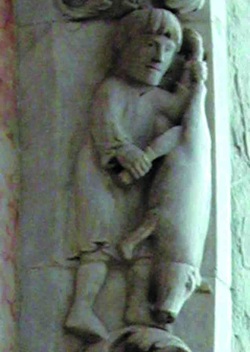
The main door of Parma’s 13th-century cathedral portrays depictions of each month of the year.  The month of November is identified by the slaughtering of a pig. To this day November is known as “November Porc” and all over the Emilia-Romagna region you will find festivals celebrating pork, pork products and particularly, Prosciutto di Parma.

pdp5
Italians serve Prosciutto di Parma in thin slices.  It can be uncooked (dry cured) which is called prosciutto crudo or cooked, called prosciutto cotto.  it is typically served as a starter to the meal. In Parma, it comes with ‘torta fritta,” parmesan cheese, fruit and wine.  It is usually served as a starter to the main meal.  It is delicious and after you have had it, I think it will be difficult to eat any other imposter.

Buon appetito!

This slideshow requires JavaScript.