Americans abroad · art · European travel · ex-pat life · Göteborg Sweden · Gothenburg Sweden · international travel · Malmö · Malmo Sweden · Skåne · Skåne Sweden · Travel

Stripes – The Swedish Summer Uniform

Let’s talk about stripes.

I’m not talking about the 1981 Bill Murray comedy or prison garb. I am talking about the recent spate of stripes in fashion. They have taken over Sweden. So much so that I felt compelled to blog about it.

I noticed immediately upon moving to Sweden that Swedish folks like stripes, but back then,  it was a cute little thing that I noticed. Today,  stripes have become the official Swedish summer uniform.  There are babies in stripes, mothers and daughters in matching stripes, old people, young people, purses, shoes, shorts, shirts, hoodies.

So. Many. Stripes. 

I noticed them in Poland, Germany and the Czech Republic to a small degree (now that my stripe antenna is up), but no where is it more prevalent that Sweden. You cannot walk 2 feet without seeing stripes.

So it left me wondering . . . is this just the latest fashion sweeping the world or is this a Swedish thing??

I asked some Swedish friends and a few shop keepers about it. None of them seemed to know why it is such a popular summer fashion theme here. One women suggested it is because Sweden is a country that has embraced water – the sea, lakes, and rivers. As such, stripes represent the nautical theme of the country. This was just her opinion though. She had no empirical evidence to offer me. I did a little research and found nothing related to Sweden, striped clothes and water.

Now, I know that striped clothing is everywhere. It is not unique to Sweden, but what is different here is the sheer number of people who seemingly overnight start wearing stripes.

How Many Stripes Are There?

Just to give you an idea of how many stripes there are in Sweden, the following pictures were taken while walking around Stockholm in a 30 minute period. 30 minutes!!  And I have about 60 more photos that I didn’t include.  I apologize for the quality – I was on the move.

In Sweden you will see royal blue and white combos:

The black and white :
The grey and white combination:

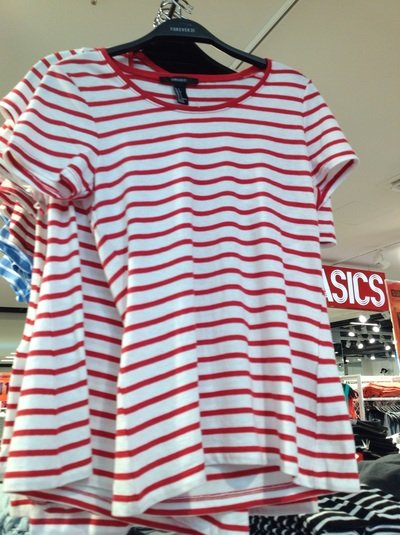
 And red and white,  red and other and just other:
The most popular choice, however, is the navy and white combination:

A little more digging and I discovered that the classic navy blue and white striped motif actually originated on the coast of Brittany in France. Many a French seaman was given a striped shirt bearing 21 horizontal stripes (one strip for each of Napoleon’s victories) as a uniform, known as a matelotor marinière.  It is reported that the stripes were functional and allowed sailors to see shipmates that had fallen overboard. How this fashion statement moved from Brittany around the world is a topic of much debate, but there is no doubt that stripes have earned a top place in the fashion world and are considered a staple of a classic wardrobe.

But back to my premise that stripes go beyond a fashion statement here in Sweden and have morphed into a uniform.  I ask you my friends – is this a Swedish thing? Have you noticed a prevalence of stripes in your neck of the woods?? Or is there another common clothing item that you have noticed where you live?  Tell me in the comments what you have noticed.

Americans abroad · European travel · ex-pat life · Göteborg Sweden · Gothenburg Sweden · international travel · Malmo Sweden · nature · Skåne · Skåne Sweden · Travel · travel

Bonfires, Bulbs and Bursts of Color – Swedish Spring

As many of you know or have read, Scandinavian winters can be long, dark and cold. Here in Sweden, springtime marks the important renewal of light and hope springs eternal. One thing I love is that it feels as if one day you have gone to sleep and the next you awake to a dramatic burst of color as the bulbs begin to flower all over Sweden. It is quite spectacular really.

To mark the momentous occasion when light returns to one’s life,  the beginning of spring in Sweden starts on April 30th on  Walpurgis Eve or Valborgsmässoafton in Swedish. The official holiday is May 1st, but the celebration begins the night before.

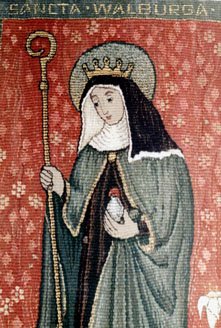
Walpurgis (also spelled Walburgis) is celebrated in many countries in Europe, and Sweden is no exception. Valborg (Swedish spelling) has been celebrated in every village and city throughout Sweden since the Middle Ages. Valborg ushers in spring and honors the life and sainthood of an 8th-century nun, St. Walpurga.

st-walpurgis-2-sized
Like many Christian celebrations, Valborg has both pagan and Christian roots.  In the days before Christianity took hold,  farmers were willing to do just about anything to insure a good crop. After all, a failing crop was the difference between life and death. At the beginning of spring each year, farmers attempted to ward off evil, ensure fertility and cleanse the land of winter. Farmers prepared the soil and nurtured it by burning all the dead dry wood, brush and grass to invite new fertile soil to emerge.

Then along came Walpurga.  As with most stories from ancient lore, St. Walpurga’s story is varied depending on who is telling it. From what I could gather,  Walpurga was a nun who is said to have performed 2 miracles during her life, saving a child from starving with 3 sheaves of wheat and calming a rabid dog.  A third miracle, which resulted in her canonization, is said to have occurred after her death.

The story goes that on the day that Walpurga was buried, the rocks making up her tomb started oozing a healing oil.  The oil was seeping from the relics that were buried with her.  The healing oil provided miraculous cures for ill people and became so significant that Walpurga’s body was reportedly removed from the tomb, dismembered and distributed around Europe to help spread the miracle.  I could not find a clear explanation as to why the church would dismember her when the oil was coming from her relics, but I digress . . .

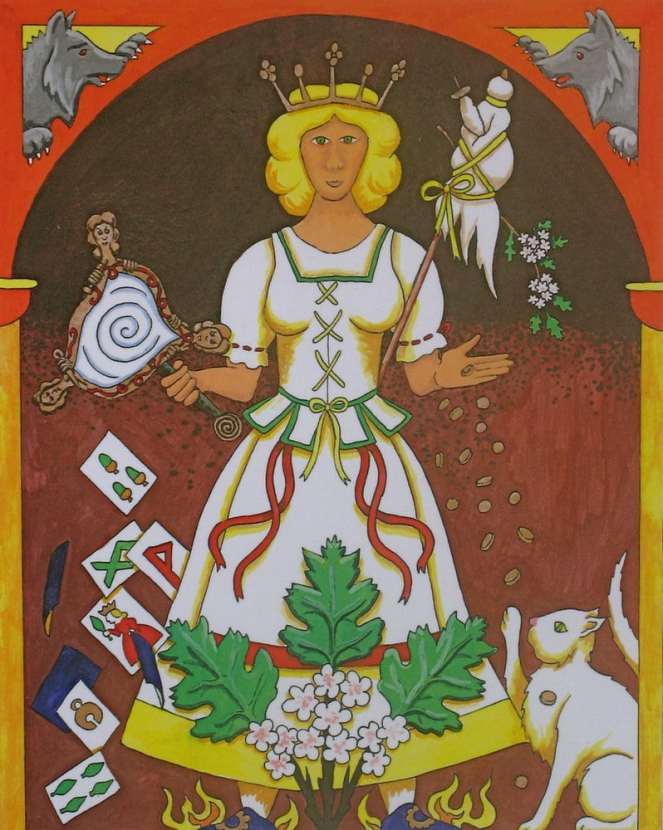
As a result of the healing oils coming from her tomb, Walpurga was canonized on May 1, 870, and became eternally tied to the pagan springtime rituals on April 30th. Today she is considered to be the saint that protects against storms, diseases and plagues, rabies, famine and failed harvests – she is essentially the patron saint of springtime.

walpurga_by_thorskegga-d4z8rl1
Photo credit: Thorskegga

My experience of  Valborg today, is that it feels akin to what we call a block party in the USA.  I have been told that bigger cities celebrations are more like a carnival, and the student cities are like an all out, city wide, drunken party, but the celebrations that I have attended are sweet gathering of family, neighbors, and friends.  People picnic, drink, sing songs. The kids play and then the main event, the bonfire is lit.
IMG_0304

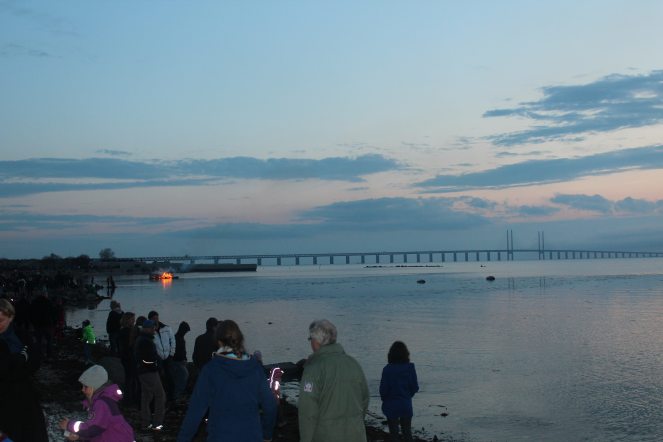
The bonfire may be small, medium or large in size. Some are burned on land, others out on the a barge on the water.  No matter where it is or the size of the fire, the bonfire is the star of the event.  Growing up in California where the grass is often quite dry and prone to brush and forest fires, I had never seen a bonfire up close. They are hot, and powerful, and oddly, a bit enchanting.

IMG_5622.jpg
A bonfire burning out on the water.

What really struck me though as an American, and a lawyer by trade, was the active participation of children of all ages in the lighting and tending of the bonfire.  Children assisted with the initial lighting and then continued to search for things to throw on the blaze. It was like a treasure hunt for flammable items. Not only were they participating, they were playing near and around the fire as it burned. Not a helicopter parent in sight. In the USA not only would each city erect barriers to keep everyone except the expert at bay (and let’s face it, to avoid any liability) but, the majority of parents would not allow their children to lend a hand or play near the fire.

I took comfort though knowing that this celebration and children’s participation in it, have been going on for longer then the USA has been a country. The Swedes seem to know what they are doing. And boy did the kids have fun.

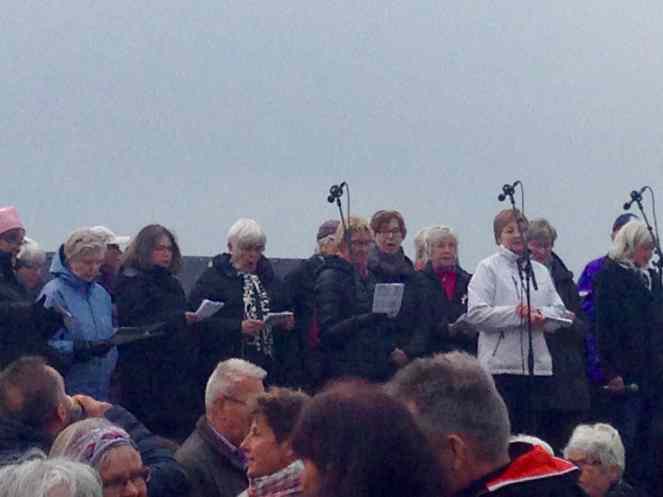
After the fire had burned down, a group of older Swedes began singing odes to spring  – songs inviting spring to please hurry and to bring sun, flowers, hiking. Songs about the joy of being outside after a long dark winter.
IMG_0310
I could not understand many of the words of the folksongs, but it didn’t matter.  The singing lent a nostalgic feel to the event, particularly because it seemed to be an older person’s gig.  It was as if there is a societal code at work. The young people burn away the old and prepare for the newness of the world, while the elders remind everyone that people have been welcoming spring in this way for centuries. It was a perfect ending to a lovely evening.

Americans abroad · European travel · ex-pat life · international travel · Malmö Sweden · Skåne Sweden · Sweden · Travel

Where The Unexpected Meets The Traditional

I went for coffee today with my daughter and discovered my new favorite cafe/store/space in Malmö, Sweden.

Hard to describe, but oh so inviting, AbSmåland is a “lifestyle concept where the unexpected meets the traditional.” It is a gardening and plant store, a cafe, a furniture store, a home design store, a space for creating and a baby store. It takes up 1450 square meters. It is a big, luscious space. And it smells reeeaally good.

We started in the cafe. AbSmåland’s café is organic and fair trade. They have the best cardamom roll in Sweden. Unfortunately, as it was not gluten free, I could only have a nibble and appreciate it from afar.


My daughter and I both had pretty decent cappuccinos (after Italy it is hard to be impressed) but the nicest bit was free regular coffee refills.We were there long enough that the lunch crowd starting wandering in. The lunch smells began wafting out of the kitchen. Did I mention that it smells really good in there? The cafe serves soup, salad, and the famous Swedish smörgås (open faced sandwiches).

After coffee and buns, we wandered around the rest of the space. I read that the space wants to invite creativity and curiosity. As such, throughout the space, there have placed windows, plants and bright colors.  


This slideshow requires JavaScript.

They also offer bedding, clothing and baby items for the ever so modern and stylish Swedish babies.

IMG_0083

IMG_0072

As I was leaving I asked one of the employees what was upstairs. “Go explore and find out” was his response. Challenge accepted. I discovered that the upper floor houses a workshop that offers creative endeavors.

At the workshop one can create: your own textile to upholster the furniture that you purchased downstairs;  your own spring bouquets with a professional florist as your teacher; spring macrame baskets; your own hanging garden and påskmys or Easter atmosphere and coziness. The workshop also facilitates sessions with local artists from time to time. 

AbSmåland’s website says that their ambition “is to offer an inspiring venue with a creative atmosphere where everyone feels welcome.” I would say that they have succeeded. I, for one,  cannot wait to return.

You can find AbSmåland at:
Södra Förstadsgatan 25/27
211 43 Malmö
072-248 89 20
hej@absmaland.com